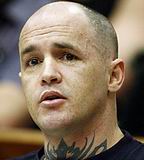
Liam Reid
Murderer William Dwane Bell
Murderer · New Zealand · 2001
William Dwane Bell (born 1978) was a convicted murderer in New Zealand. Bell wa…
3 victims
William Dwane Bell
Murderer · New Zealand · 2001
William Dwane Bell (born 1978) was a convicted murderer in New Zealand. Bell wa…
3 victims
 Bruce Howse
Murderer · New Zealand · 2001
Bruce Howse was the partner of Charlene Aplin and the stepfather of Saliel Apli…
2 victims
Bruce Howse
Murderer · New Zealand · 2001
Bruce Howse was the partner of Charlene Aplin and the stepfather of Saliel Apli…
2 victims
 Mark Edward Lundy
Murderer · New Zealand · 2000
Mark Edward Lundy was the husband and father of the victims Christine Marie Lun…
2 victims
Mark Edward Lundy
Murderer · New Zealand · 2000
Mark Edward Lundy was the husband and father of the victims Christine Marie Lun…
2 victims
 Scott Watson
Murderer · New Zealand · 1998
Scott Watson (born 28 June 1971) was a New Zealander who was convicted in May 1…
2 victims
Scott Watson
Murderer · New Zealand · 1998
Scott Watson (born 28 June 1971) was a New Zealander who was convicted in May 1…
2 victims
 Antonie Dixon
Murderer · New Zealand · 2003
Antonie Ronnie "Tony" Dixon (1968 – 4 February 2009) · 21 January 2003 — Dixon…
1 victim
Antonie Dixon
Murderer · New Zealand · 2003
Antonie Ronnie "Tony" Dixon (1968 – 4 February 2009) · 21 January 2003 — Dixon…
1 victim
 Clayton Weatherston
Murderer · New Zealand · 2008
Clayton Weatherston Sophie Kate Elliott was born 11 June 1985 and was 22 years…
1 victim
Clayton Weatherston
Murderer · New Zealand · 2008
Clayton Weatherston Sophie Kate Elliott was born 11 June 1985 and was 22 years…
1 victim
 Paul Harold Orgeron
Mass murderer · USA · 1959
Paul Harold Orgeron died in the explosion. Paul Harold Orgeron was an ex-convic…
5 victims
Paul Harold Orgeron
Mass murderer · USA · 1959
Paul Harold Orgeron died in the explosion. Paul Harold Orgeron was an ex-convic…
5 victims
 Kenneth Fults
Murderer · USA · 1996
Kenneth E. Fults was sentenced to death in Spalding County for killing a neighb…
1 victim
Kenneth Fults
Murderer · USA · 1996
Kenneth E. Fults was sentenced to death in Spalding County for killing a neighb…
1 victim
 Michael Tenneson
Murderer · USA · 1987
Michael Tenneson was born in 1960 and was a native of Holmen, Wisconsin. He was…
5 victims
Michael Tenneson
Murderer · USA · 1987
Michael Tenneson was born in 1960 and was a native of Holmen, Wisconsin. He was…
5 victims
 Gerald Tigner
Murderer · USA · 1992
Gerald Wayne Tigner was convicted of the capital murders of Michael Watkins and…
3 victims
Gerald Tigner
Murderer · USA · 1992
Gerald Wayne Tigner was convicted of the capital murders of Michael Watkins and…
3 victims
 Crystal Wagner
Murderer · USA · 2005
Crystal Mae Wagner (also referred to as Crystal Wagner), 29, was accused of kil…
1 victim
Crystal Wagner
Murderer · USA · 2005
Crystal Mae Wagner (also referred to as Crystal Wagner), 29, was accused of kil…
1 victim
- Gender
- male
- Country
- New Zealand
- Location
- Christchurch, Canterbury, South Island, New Zealand
- Date of birth
- July 1972
- Age at first offence
- 35
- Characteristics
- rape, kidnapping
- Victim profile
- Emma Agnew, 20
- Method of murder
- Suffocation
- Date(s) of murder
- November 15, 2007
- Years active
- 2007
- Date of arrest
- November 27, 2007
- Status
-
Minimum 26 years without parole on December 12, 2008; minimum reduced to 23 years without parole in July 2009
Background
Liam Reid was convicted of rape and murder and later described by a sentencing judge as “an evil and dangerous predator”. He had a previous trial in October 2002 involving a woman that included charges of abducting a woman, sexually violating her, and attempting to murder her during a session of experimental sex he described as “cool”. He was acquitted of all those charges in October 2002.
During the October 2002 proceedings, Reid used a different name, Julian Heath Edgecombe. He had also been convicted of fraudulently using the victim’s bank card while he was on the run, when he knew she had gone to the police.
Reid later faced a rape and murder trial for the killing of deaf Christchurch woman Emma Agnew, and for the rape and attempted murder of a Dunedin student. The sentencing hearing for the later convictions included preventive detention consideration.
The offence
Murder and rape of Emma Agnew
Emma Agnew was a deaf Christchurch woman aged 20. She was killed after she went missing following texting her family to say she was planning to meet a man who was interested in buying her car. Her burnt-out car was found in Bromley Park in eastern Christchurch.
Her body was found hidden in scrub near the Spencer Park Motor Camp, 15 kilometres northeast of Christchurch. The description of the death included that she was suffocated with a sock.
Dunedin student attack
Reid also raped and attempted to murder a Dunedin student a few days after the killing of Emma Agnew. The assault involved rape, sexual violation, attempted murder, and robbery, and included prolonged rape and attempted murder. The Dunedin victim was described as a 21-year-old student.
The prolonged rape and attempted murder was described as involving strangling, and the rope was said to have been used to choke her during the sexual assault. A description included that she belted him in the testicles and got away.
Investigation
The court heard evidence that rough sex Reid indulged in was “a signature” which linked him to both Emma Agnew’s murder and the Dunedin attack. The two women suffered deep genital bruising.
The Crown sought to support the case with phone records and forensic evidence. The Crown also relied on an admission to his girlfriend that he raped and murdered Emma Agnew and admitted raping a student in Dunedin.
Arrest
Liam James Reid was arrested on November 27 after an armed offenders squad raid on a Christchurch boarding house.
Initial court appearance was made on November 28, with members of the public scuffling and shouting obscenities at him.
Trial
Verdict and sentencing hearing date
In October 2008, a jury found Liam James Reid guilty of the rape and murder of Christchurch woman Emma Agnew, and the brutal rape of another woman. The jury returned guilty verdicts on all charges he faced.
A jury of seven men and five women returned the verdict in the High Court in Christchurch. The verdict was unanimous.
Reid had pleaded not guilty to the rape and murder of Emma Agnew in Spencer Park north of Christchurch in November last year, and to raping, sexually violating, robbing and attempting to murder a 21-year-old Dunedin student nine days later.
What the jury considered
The jury deliberated for four hours after hearing four weeks worth of evidence from more than 100 witnesses.
Justice Chisholm sentenced Reid to life imprisonment and considered whether to impose a preventive detention order at a hearing on December 12. The Crown said it would seek preventive detention.
Detective senior sergeant Tom Fitzgerald, officer in charge of the case, said the Crown would push for a preventive detention sentence for Reid and described the investigation as lengthy.
Defence counsel David Bunce urged jurors to disregard aspects of Reid’s appearance or behaviour they found “strange to you or not to your taste”. Bunce described Reid as having been frank and having “let it all hang out” in the witness box.
Bunce attacked the credibility of the Crown’s main witness and said the Crown had thrown “everything but the kitchen sink” at Reid.
Bunce also urged jurors to consider the case without prejudice and said the Crown had to prove the case.
Defence and prosecution positions
Reid gave evidence in his own defence, denying all the charges and claiming he had been framed. He suggested police planted evidence. He claimed that the scientific evidence must have arisen from accidental transference, contamination or from being planted.
The judge cautioned jurors not to play detective and to stay away from the internet.
The judge directed the jury to consider the case without prejudice and said the onus was on the Crown to prove the case, and that Reid’s testimony should not count against him even if jurors found it unreliable.
Sentencing
On December 12, 2008, Reid was sentenced to preventive detention with a minimum non-parole period of 26 years.
Justice Lester Chisholm described Reid meeting his Dunedin victim nine days after the murder as “just like an animal would with its prey”. He said the judge was satisfied it was violent in the extreme and described the acts as “callous and despicable acts, Mr Reid.” The judge also stated that Reid had not been deterred.
The sentencing involved a public gallery packed to see sentencing, with members of the deaf community and sign language interpretation.
Justice Chisholm said Emma Agnew’s deafness made her “deaf and vulnerable to your evil designs” and addressed Reid’s conduct in relation to the Dunedin attack as premeditated. The judge said Reid had with him the rope used to choke her during the sexual assault.
Reid still denies all the offending and refuses to take treatment. Attempts at treatment had been stopped because of his hostility.
Justice Chisholm told Reid:
“You are arrogant. You seek to dominate, particularly women. You are not lacking in intelligence and that is one of the dangers that underlie your activities. Sadly, there is not the slightest flicker of remorse. To sum up, you are an evil and dangerous predator.” He said there was not the slightest doubt that the jury had got it right.
The Crown prosecutor Pip Currie said the Crown sought up to 22 years non-parole term for the rape and murder of Emma Agnew and an uplift for the Dunedin attack. Currie said reports revealed Reid’s sadistic sexual fantasies about rape and murder and described him becoming blind with rage when angry, including picturing himself “squeezing people’s heads until they pop”.
Currie also said Reid had reported in detail that he would like to rape and murder and dispose of female victims and spoke of childhood desire to kill animals because he found that satisfying, but he thought killing a person would be better.
Currie said Reid had 61 previous convictions for threats, assaults and two aggravated robberies, and that none were for sexual offending.
Defence counsel David Bunce urged a minimum non-parole term of no more than 20 years. Bunce also said preventive detention was not an additional penalty but was imposed for continuing safety of the community and that it was inherently difficult to predict likelihood of further offending so many years in advance. Bunce argued that the Parole Board would be in a better position to decide at the time.
Justice Chisholm said it would have been immediately obvious to Reid when he met Emma Agnew that she was “deaf and vulnerable to your evil designs”. He said Reid had strangled her and meant to leave her for dead.
Justice Chisholm said the judge believed the Dunedin attack involved a woman who was drunk and vulnerable, and that Reid had strangled her and meant to leave her for dead.
Reid was described as shaven headed, tattooed, and flanked by three prison officers, and he bowed to the crowd and raised both arms as he was led away.
Reid will be 62 when he becomes eligible for consideration for parole.
Appeals
Reid had an initial appeal against the conviction dismissed by the Court of Appeal in July 2009. An application for leave to appeal was not made to the Supreme Court until February 21, 2011, more than a year and a half out of time.
Reid claimed there was late disclosure by the prosecution of certain DNA evidence and evidence of the tracking of the murdered woman’s mobile phone, and that the defence was unable to review that evidence before the trial, therefore a miscarriage of justice had occurred.
Reid’s lawyer had been instructed for the appeal to the Supreme Court but said that because legal aid funding had not been made available, he was not in a position to advise Reid on whether there were grounds to appeal.
The Supreme Court judgment included the following:
“Nothing has been put before this court which could provide any basis for the conclusion that either the DNA evidence or the evidence of the tracking of the mobile phone was actually unreliable, so that a substantial miscarriage of justice may have occurred. The suggestion that upon a review either of those pieces of evidence may prove to be suspect in some respect is therefore entirely speculative. ” “In these circumstances, and in the absence of any indication that the position concerning funding is likely to change, no grounds have been established for the proposed appeal. The application for leave must therefore be dismissed.” The application for leave to appeal was dismissed.
Outcome
Liam James Reid was found guilty of:
- The murder and rape of Christchurch woman Emma Agnew, 20.
- The rape and attempted murder of a Dunedin student. At sentencing, he received a life sentence with preventive detention considered and imposed a minimum non-parole period.
His minimum non-parole term was set at 26 years, and this was later cut on appeal to a minimum 23 years without parole in July 2009.
Reid’s appeal application to the Supreme Court for leave to appeal was dismissed.
Other details
Family and court reactions
Emma Agnew’s father Henry Agnew said the verdict was “really, really good” and the family were “very relieved,” stating: “We miss Emma so much,” through a sign language interpreter. He said: “It has to be life. It has to be life.” He expressed thanks for support given to the family, saying: “The deaf community have been really good,” and: “I would like to say thanks to the police for all the work they have put in. The lawyers as well. They have done a fantastic job. We are a very close family so we will just keep going.” He added: “We are really thankful that both trials could be heard together.”
Outside court, the family of Miss Agnew said they believed the judge had made the right decision but that it would not bring Emma back. Emma Agnew’s brother Toby said: “We can finally have peace. We can finally be left alone. We can think about our sister.” Agnew’s aunt, Evelyn Pateman, said Reid’s performance at the end showed he thought it was “all a game”.
Reid’s previous proceedings and prison background (including acquittal in 2002)
Reid had been acquitted in October 2002 of charges involving abducting a woman, sexually violating her, and attempting to murder her during a session of experimental sex he described as “cool”. He had been convicted of fraudulently using the victim’s bank card while he was on the run, when he knew she had gone to the police.
In the 2002 trial, the woman’s narrative included “hard out, furious, fast, deviant, experimental, disgusting sex. It was cool. To us it was normal.” Reid described “reconciliation sex” and said he needed to protect himself because of threats she made to have him charged and to harm his daughter. The pair argued and she wrote a note saying she had not been raped and it referred to spanking. Handcuffing, spanking, and asphyxia were part of the sex games Edgecombe admitted playing with the woman.
After the acquittals on the sex charges in October 2002, Edgecombe was remanded for sentence on the bank card charge and received a three-month jail term.
He had been marked by violence during his time in prison on remand, including an admission in November 2002 of attacking two prison inmates in a frenzied bashing with a broom handle and breaking a broom handle over one man who was struck repeatedly. He bashed the second victim over the head when he tried to intervene.
Judge David Holderness referred to Edgecombe’s bad list of previous offending, including violence, and jailed him for 27 months.
He was acquitted in 2003 on a charge of assaulting another inmate with intent to injure. The charge alleged he had thrown a mug of boiling water in the other man’s face and then punched him 15 times.
Edgecombe also attacked a convicted paedophile in prison. The attack may have left George Darren Cant eligible for tens of thousands of dollars in compensation. George Darren Cant was described as being in jail for molesting five children at a church camp.
When Edgecombe was cuffed by a prison officer he claimed $40,000 compensation, but it was refused in a decision by Christchurch District Court Judge Stephen Erber in July 2005. The prison officer lost his job over the incident. Edgecombe claimed the compensation for “hurt feelings”.
After Judge Erber refused compensation, Justice Minister Phil Goff said:
“It vindicates the government’s judgement that this legislation (the Prisoners and Victims Claims Act) would be effective in stopping golden handshakes for inmates where disciplinary action against an errant prison officer dealt more effectively with the problem.”
Timeline of Emma Agnew murder case events
- November 15, 2007 — Emma Agnew went missing after texting her family to say she was planning to meet a man who was interested in buying her car; her burnt-out car was found in Bromley Park that night.
- November 26 — Emma Agnew’s body was found hidden in scrub near the Spencer Park Motor Camp, 15 kilometres northeast of Christchurch; she was described as being suffocated with a sock.
- November 27 — Liam James Reid was arrested after armed offenders squad raid on a Christchurch boarding house.
- November 28 — Reid made initial court appearance, with members of the public scuffling and shouting obscenities at him; speculation surfaced that Reid could be responsible for the savage rape of a 21-year-old woman in Dunedin only days earlier.
- April 3, 2008 — Reid was committed for trial for Emma Agnew’s murder after a four-day depositions hearing in Christchurch District Court.
- October 6 — Reid’s murder trial began; he was charged with the Dunedin sex attack nine days after he killed Emma Agnew; counts of attempted murder, rape, sexual violation, and robbery were added to the rape and murder charges.
- October 20 — Crown told the court that rough sex Reid indulged in was “a signature” linking him to both Emma Agnew’s murder and the Dunedin attack; both women suffered deep genital bruising.
- October 31, 2008 — Reid was found guilty on all charges after less than four hours of jury deliberation; he was jailed for life and the Crown would seek preventive detention at a sentencing hearing set down for December 12.
- December 12 — Reid was sentenced to preventive detention with a minimum non-parole period of 26 years.
Contraband smuggling conviction involving Liam Reid
Lawyer Davina Murray was found guilty of smuggling contraband items to convicted murderer and rapist Liam Reid in prison. Judge Russell Collins found Ms Murray, a former Maori Party candidate, guilty of smuggling an iPhone, cigarettes and a lighter into Mt Eden Prison for her alleged boyfriend. The proceedings included phone calls between Ms Murray and Reid being played in court, and text messages from Ms Murray to friends being read out, including: “I hate that I’m in love with him but I’m scared to lose him,” and: “I love him like I have never loved anyone before,” and: “the best kisser I’ve ever kissed”. Reid said: “She’s the only person that’s ever stood by me. So she’s my lawyer, but I also consider her a friend.” Ms Murray said she would file an application to be discharged without conviction.


Spotted an error, or have more information about this case?