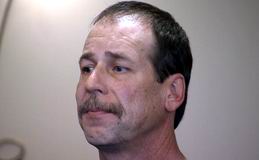
Theodore Wafer
Murderer Leon Davis Jr.
Murderer · USA · 2007
Leon Davis Jr. was sentenced to death on April 29, 2011, for the execution-styl…
5 victims
Leon Davis Jr.
Murderer · USA · 2007
Leon Davis Jr. was sentenced to death on April 29, 2011, for the execution-styl…
5 victims
 Raymond Lee Oyler
Murderer · USA · 2006
Raymond Lee Oyler was convicted for starting the 2006 Esperanza fire in Riversi…
5 victims
Raymond Lee Oyler
Murderer · USA · 2006
Raymond Lee Oyler was convicted for starting the 2006 Esperanza fire in Riversi…
5 victims
 Anthony Garcia
Murderer · USA · 2008
Anthony Garcia was a former doctor who was found guilty on all counts including…
4 victims
Anthony Garcia
Murderer · USA · 2008
Anthony Garcia was a former doctor who was found guilty on all counts including…
4 victims
 Brian Gene Nichols
Murderer · USA · 2005
Brian Gene Nichols was born December 10, 1971. He was known for his escape and…
4 victims
Brian Gene Nichols
Murderer · USA · 2005
Brian Gene Nichols was born December 10, 1971. He was known for his escape and…
4 victims
 Bruce Mendenhall
Murderer · USA · 2007
Bruce Mendenhall grew up in Crawford County, Illinois. He was married and has t…
4 victims
Bruce Mendenhall
Murderer · USA · 2007
Bruce Mendenhall grew up in Crawford County, Illinois. He was married and has t…
4 victims
 Henry Lee Jones
Murderer · USA · 2003
Henry Lee “Bam” Jones grew up without a father in Cleveland, Miss. He grew up w…
4 victims
Henry Lee Jones
Murderer · USA · 2003
Henry Lee “Bam” Jones grew up without a father in Cleveland, Miss. He grew up w…
4 victims
 Leonel Torres Herrera
Murderer · USA · 1981
Leonel Torres Herrera was executed by lethal injection in Texas on May 15, 1993…
2 victims
Leonel Torres Herrera
Murderer · USA · 1981
Leonel Torres Herrera was executed by lethal injection in Texas on May 15, 1993…
2 victims
 Vincent James
Murderer · USA · 1989
Vincent James instructed Gayle Taylor, an employee, to give him her ring, and s…
1 victim
Vincent James
Murderer · USA · 1989
Vincent James instructed Gayle Taylor, an employee, to give him her ring, and s…
1 victim
 George Alarick Jones
Murderer · USA · 1992
April 13, 1993 — George Alarick Jones and three accomplices went to the Red Bir…
2 victims
George Alarick Jones
Murderer · USA · 1992
April 13, 1993 — George Alarick Jones and three accomplices went to the Red Bir…
2 victims
 Robert William Clayton
Murderer · USA · 1985
Robert William Clayton was a Tulsa death row inmate. He had an IQ of 68 and pre…
1 victim
Robert William Clayton
Murderer · USA · 1985
Robert William Clayton was a Tulsa death row inmate. He had an IQ of 68 and pre…
1 victim
 John Giuca
Murderer · USA · 2003
John Giuca was born October 1983. He was an American man who studied criminal j…
1 victim
John Giuca
Murderer · USA · 2003
John Giuca was born October 1983. He was an American man who studied criminal j…
1 victim
- Gender
- male
- Country
- USA
- Location
- Dearborn Heights, Michigan, USA
- Date of birth
- 1959
- Age at first offence
- 54
- Characteristics
- rape?
- Victim profile
- Renisha McBride, 19
- Method of murder
- Shooting ( 12-gauge Mossberg shotgun)
- Date(s) of murder
- November 2, 2013
- Years active
- 2013
- Date of arrest
- Same day
- Status
-
Imprisoned
Sentenced to 17 to 32 years in prison on September 3, 2014
Case overview
The case concerned the shooting of Renisha McBride, a 19-year-old African-American woman, in Dearborn Heights, Michigan, United States. Renisha McBride crashed her car in Detroit and then walked to a neighborhood in Dearborn Heights where she loudly knocked on the windows and the door of a house. The homeowner, Theodore Paul Wafer, shot McBride with a shotgun.
The offence
On November 2, 2013, McBride died after being shot by Theodore Paul Wafer, 54, on the porch of his Dearborn Heights home.
Wayne County Prosecutor Kym Worthy stated that Wafer opened his front door and fired a shotgun blast through a screen door, hitting McBride in her face.
Wafer initially stated to police that he thought his home was being broken into after he heard her banging on his door at 4:42 in the morning, and that he accidentally fired his 12-gauge shotgun. Firearms expert David Balash, who testified for the defense, believed the screen in the outer door was out of its frame before the shot was fired, suggesting McBride may have knocked it out of place, causing alarm in the homeowner. Prosecutors blamed the blast for displacement.
It remained unclear what McBride was doing during the three hours between the crash and the fatal shooting. McBride’s family stated that she was looking for help after becoming disoriented by the crash, in which she may have sustained a head injury.
The Wayne County Medical Examiner’s Office reported that McBride was highly intoxicated at the time of her death. Police records also indicated that she had been involved in a car crash about a mile away before the shooting, and that her autopsy showed she was extremely drunk. An autopsy report cited a blood-alcohol level of about 0.22, and she was also reported to have been smoking marijuana. The Wayne County Medical Examiner’s Office also stated that bodies can arrive with maggots in various stages of decomposition and that this was a regular occurrence associated with death scenes.
Investigation
Police report that the 911 caller said a woman had been speeding down the street, struck a parked car, got out of the vehicle, and then left on foot. Police initially considered the incident a low priority, so no officers were immediately dispatched. Forty minutes later, another call was placed indicating that the driver had returned.
EMS arrived on the scene, but McBride had again walked away from the scene and was not treated.
The owner of the parked car, who encountered McBride and called 911, told police that McBride was “discombobulated” and appeared to be in a “confused state of not knowing where she was and not being able to give a phone number or anything.”
A toxicology report released Thursday showed that McBride had alcohol and marijuana in her system. The autopsy released this week ruled McBride died of a large gunshot wound to her face.
During testimony, police described aspects of their timeline and evidence handling. A Dearborn Heights police Cpl. Mark Parrinello testified that authorities returned to a tow yard to photograph McBride’s car and later to collect blood samples. Under cross-examination, Parrinello acknowledged that it would be “wise” to collect evidence as soon as an incident occurred and that it was possible to lose evidence if it was not collected quickly and efficiently.
Defense counsel argued that the investigation was incomplete and inadequate and that evidence was lost. An officer said the doors on Wafer’s home were dusted for fingerprints on Nov. 11 during questioning by Wafer’s attorney.
Photographs from the scene showed a torn screen door, a shotgun on the floor near the front door, a spent shotgun shell casing, a gun case, and McBride with blood. Several relatives left the courtroom when the pictures played.
Prosecutors also played audio from a microphone worn by a responding officer. The jury heard this exchange:
“Where’s the gun?” Wafer replied, “It’s on the ground inside the landing right there.”
Then police asked what happened. Wafer stated:
“A consistent knocking on the door, and I’m trying to look through the windows, but every time I look through the windows and the door, it’s banging somewhere else, so I open up the door, kind of like, ‘Who is this?’ and the gun discharged,”
Wafer also said:
“I don’t get it. Who’s knocking on your door at 4:30 in the morning? Bang, bang, bang. Somebody wanting in.”
Police officers also asked Wafer about his weapon. Wafer replied: “It’s a little Mossberg, you know, shotgun. Self-defense.”
Detective Sgt. Steve Gurka testified that Wafer’s Mossberg shotgun was found inside near the front door with the spent shell still inside the firearm. A gun case was found on the floor in another area of the house.
A sergeant testified to what he observed upon arriving: “I observed a black female lying on the porch on her back with her feet directed towards the door.”
Police recovered McBride’s driver’s license and $56 from McBride’s back pants pocket.
Parrinello testified that he had to take six to eight maggots off of McBride’s clothing, and that the transfer occurred from a medical examiner setting where there was another gurney with some tissue on it, which turned out to be deer meat with maggots. A spokeswoman with the Wayne County Medical Examiner’s Office said the office did not have deer meat or store animals unless it was “necessary to retrieve a bullet for comparison or something related to a crime,” and said it was “not uncommon” for bodies to come into the office with maggots. She said:
“Many of the bodies are in various stages of decomposition when they arrive,” and “It is a regular occurrence associated with death scenes.”
Arrest and charges
On November 15, 2013, the Wayne County prosecutor’s office announced its decision to prosecute Wafer for second-degree murder, manslaughter, and possession of a firearm during commission of a felony.
Wafer faced a maximum possible sentence of life imprisonment for the second-degree murder charge, 15 years for manslaughter, and an additional two years for the felony gun charge.
Wafer was charged with second-degree murder and was also described as facing trial on second-degree murder and manslaughter after a judge rejected his self-defense argument.
Trial
The trial began in June 2014.
Wafer’s defense argued that he shot McBride in self-defense.
A firearms expert, David Balash, testified that he believed the screen in the outer door was out of its frame before the shot was fired, suggesting McBride may have knocked it out of place and raised Wafer’s fears.
Prosecutors argued that Wafer created a situation where death or great bodily harm was likely to occur and that his actions were “unnecessary, unjustified and unreasonable.” Prosecutors also contended that Wafer should have called police if he feared for his safety.
At one point during the proceedings, Dearborn Heights Judge David Turfe rejected Wafer’s self-defense argument and stated:
“We can’t allow (someone) to use a bad decision as a shield to criminal prosecution... The defendant made a bad choice,”
Wafer’s attorney, Cheryl Carpenter, argued under Michigan’s 2006 self-defense law, saying:
“If someone is breaking into a home there is a presumption that a homeowner can use deadly force,” and: “You don’t know how many people are out there... There’s violent banging on the front door. We have a man alone in his home.”
Wayne County assistant prosecutor Danielle Hagaman-Clark responded by saying it was “ridiculous” to believe Wafer was deeply afraid but still decided to open the door and fire instead of first calling the police, and she stated:
“He shoved that shotgun in her face and pulled the trigger,”
At trial, Wafer testified that he was in fear of his life. Prosecutors said a jury was convinced that Wafer intended to kill and that he had previous experience with firearms and other options to resolve the situation.
On August 7, 2014, Wafer was found guilty of all three charges.
Sentencing
On September 3, 2014, Wafer was sentenced to 17 to 32 years in prison.
The sentencing included a mandatory two-year sentence for felony firearm usage, followed by concurrent sentences of seven to 15 years for manslaughter and 15 to 30 years for second-degree murder. The result meant Wafer would serve at least 17 years in prison before being eligible for parole and could serve up to 32 years.
Wayne County Circuit Court Judge Dana Hathaway made the following statements while sentencing Wafer:
“This one of the saddest cases,” “An unjustified fear is never an excuse to take someone’s life.”
Wafer’s private attorney, Cheryl Carpenter, stated that Wafer would appeal the conviction and requested a public defender to handle the appeal.
During the sentencing hearing, McBride’s father, Walter Simmons, told the court:
“I’ll never have the opportunity to see her grow up, be a woman and have kids,”
Gerald Thurswell, a lawyer representing McBride’s family, said the family was “very happy” with the sentence.
The prosecution had asked for at least 17 years for Wafer, who was convicted on August 7.
Wafer asked McBride’s family for forgiveness, stating:
“From my fear I caused the loss of a life who was too young to leave this world,” “From that I will carry this guilt and sorrow forever.”
Carpenter argued for a lesser sentence, stating that the crime was not premeditated and that Wafer could be rehabilitated. She stated that 17 years was:
“like a death sentence for a 55-year-old man because ‘one year in prison is like five years on the outside.’”
Appeals
Wafer’s attorney said he would appeal the conviction and requested a public defender to handle the appeal.
Outcome
Wafer was convicted of second-degree murder, manslaughter, and possession of a firearm during commission of a felony on August 7, 2014, and was sentenced to 17 to 32 years in prison on September 3, 2014.
Aftermath and reaction
The shooting prompted protests and demands for prosecution of the homeowner. Reverend Al Sharpton and protesters likened the shooting to the February 2012 killing of Trayvon Martin and stated that McBride may have been racially profiled.
Kym Worthy stated that the decision to charge Wafer had “nothing to do whatsoever with the race of the parties,” and she expressed no opinion about whether race would later become relevant.
Gerald Thurswell stated that if Wafer had called 911 when he heard McBride outside his house, police would have been there “within two minutes” and McBride would have been alive, saying:
“Maybe she would have been arrested for being intoxicated, but she would not be dead.”
McBride’s parents, Simmons and Monica McBride, filed a $10 million wrongful death suit against Wafer shortly after his criminal trial ended.
Other details
Wafer was described as an airport maintenance worker and as a white homeowner. Wafer was also described as 54 or 55 in different parts of the proceedings and reporting.
McBride’s family said she may have sustained a head injury in the car crash.
A 911 call recording included this statement by Wafer:
“Uh yes... I just shot somebody on my front porch. with a shotgun, banging on my door.”
Wafer gave his address during the call and ended it with “thank you” and hung up while police dispatch continued. The same recording indicated Wafer called after he shot McBride to report the incident and then hung up, and he called back and told police that he didn’t know who it was he had shot.
A Daily Beast description included statements from an ex-girlfriend of Wafer. The ex-girlfriend said:
“He drank a lot, but he was never violent,” and she also stated: “I can’t say for sure, but he may have been the baby of the family.” She also described a civil dispute involving legal expenses of $3,000 and said she later found $3,000 in cash stuffed in a bag inside her door.
Another comparison was made in public discussion between the McBride shooting and the fatal shooting of Trayvon Martin.
There were also descriptions of what McBride wore and what police recovered at the scene, including her driver’s license and $56 in her back pants pocket.
Spotted an error, or have more information about this case?