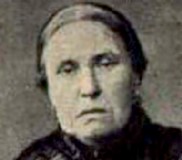
Catherine Flannagan
Murderer Jessie King
Murderer · United Kingdom · 1887
Jessie King was executed in Edinburgh on March 11, 1889, and she was described…
2 victims
Jessie King
Murderer · United Kingdom · 1887
Jessie King was executed in Edinburgh on March 11, 1889, and she was described…
2 victims
 Mary Pearcey
Murderer · United Kingdom · 1890
Mary Pearcey (Mary Eleanor Wheeler; also known as Mary Eleanor) was born in 186…
2 victims
Mary Pearcey
Murderer · United Kingdom · 1890
Mary Pearcey (Mary Eleanor Wheeler; also known as Mary Eleanor) was born in 186…
2 victims
 Kate Webster
Murderer · United Kingdom · 1879
Kate Webster was executed by hanging at Wandsworth Prison on July 29, 1879. · 2…
1 victim
Kate Webster
Murderer · United Kingdom · 1879
Kate Webster was executed by hanging at Wandsworth Prison on July 29, 1879. · 2…
1 victim
 Louisa Jane Taylor
Murderer · United Kingdom · 1882
Louisa Jane Taylor was widowed in 1882 and had a small pension to survive on. S…
1 victim
Louisa Jane Taylor
Murderer · United Kingdom · 1882
Louisa Jane Taylor was widowed in 1882 and had a small pension to survive on. S…
1 victim
 Margaret Waters
Murderer · United Kingdom · 1866
Margaret Waters was an English murderess who was hanged by executioner William…
19 victims
Margaret Waters
Murderer · United Kingdom · 1866
Margaret Waters was an English murderess who was hanged by executioner William…
19 victims
 George Joseph Cvek
Murderer · USA · 1941
George Joseph Cvek was 23 when detectives identified him from a fingerprint. Ca…
1 victim
George Joseph Cvek
Murderer · USA · 1941
George Joseph Cvek was 23 when detectives identified him from a fingerprint. Ca…
1 victim
 Calvin Shuler
Murderer · USA · 1997
Calvin Alphonso Shuler was sentenced to death for killing guard James “J.B.” Br…
1 victim
Calvin Shuler
Murderer · USA · 1997
Calvin Alphonso Shuler was sentenced to death for killing guard James “J.B.” Br…
1 victim
 Terry Blair
Serial killer · USA · 1982
Terry Blair (born September 16, 1961) was an American serial killer who raped a…
9 victims
Terry Blair
Serial killer · USA · 1982
Terry Blair (born September 16, 1961) was an American serial killer who raped a…
9 victims
 Ricardo Gonzalez
Murderer · USA · 1992
Ricardo Gonzalez was indicted in the Eleventh Judicial Circuit, Dade County. On…
1 victim
Ricardo Gonzalez
Murderer · USA · 1992
Ricardo Gonzalez was indicted in the Eleventh Judicial Circuit, Dade County. On…
1 victim
 Mark Schwab
Murderer · USA · 1991
Mark Dean Schwab (born December 16, 1968; white; male; hair brown; blue eyes; 6…
1 victim
Mark Schwab
Murderer · USA · 1991
Mark Dean Schwab (born December 16, 1968; white; male; hair brown; blue eyes; 6…
1 victim
- Gender
- female
- Country
- United Kingdom
- Location
- Liverpool, Merseyside, England, United Kingdom
- Date of birth
- 1829
- Age at first offence
- 54
- Characteristics
- poisoner, attempt to collect insurance money
- Victim profile
- Thomas Higgins, 45 (her brother-in-law)
- Method of murder
- Poisoning (arsenic)
- Date(s) of murder
- October 2, 1883
- Years active
- 1883
- Date of arrest
- October 16, 1883
- Status
-
Executed
Executed by hanging at Kirkdale Prison on March 3, 1884
Overview
Catherine Flannagan and her sister Margaret Higgins used arsenic to poison people in Liverpool and collected burial society and insurance payouts after deaths. They were convicted of murder and were executed by hanging on March 3, 1884 at Kirkdale Prison.
People
- Catherine Flannagan (55) — one of the sisters convicted of murder by poisoning; arrested and later hanged.
- Margaret Higgins (41) — Catherine’s sister; convicted of murder by poisoning; arrested and later hanged.
- Thomas Higgins (36) — Margaret Higgins’s husband; died after apparent illness; the murder charge at trial.
- John Flannagan (22) — Catherine’s son; died suddenly in December 1880; exhumed later and found to have traces of arsenic.
- Mary Higgins (8; also described as Thomas’s 10-year-old daughter) — Thomas Higgins’s daughter; died after a short illness; exhumed later and found to have traces of arsenic.
- Patrick Jennings — lodger associated with the Jennings household; pursued the matter after his brother became suspicious.
- Margaret Jennings (18; also described as 19) — lodger; exhumed later and found to have traces of arsenic.
- Margaret Evans — named by Catherine Flannagan as a poisoner in an alleged conspiracy.
- Bridget Begley — named by Catherine Flannagan as a poisoner in an alleged conspiracy.
- Margaret Potter — named by Catherine Flannagan as an insurer in an alleged conspiracy.
- Mrs Fallon — named by Catherine Flannagan as an insurer in an alleged conspiracy.
- Bridget Stanton — named by Catherine Flannagan as an insurer in an alleged conspiracy.
- Catherine Ryan — named by Catherine Flannagan as an accomplice in an alleged conspiracy.
- Doctor Whitford — doctor called when Thomas Higgins became ill; attributed the illness to dysentery related to cheap whiskey.
- Dr Campbell Brown — poison expert who verified the presence of arsenic in evidence examined.
- William Marks — prosecuting solicitor for Liverpool who corresponded with the Director of Public Prosecutions.
- Angela Brabinan — a retired criminal lawyer who later argued that additional people may have been responsible in a larger scheme.
- Bartholomew Binns — executioner who hanged the sisters with an assistant.
Timeline
- December 1880 — John Flannagan died suddenly in the household at 5 Skirving Street.
- October 1882 — Margaret married Thomas Higgins.
- January 1883 — Margaret Jennings died.
- 1883 (September) — Thomas Higgins became ill with severe stomach pains while living at 27 Ascot Street.
- 1883 (two days after illness began) — Thomas Higgins died.
- 1883 (nearly a week after arrest of Margaret Higgins) — Catherine Flannagan moved between boarding houses to avoid police for nearly a week before being taken into custody in Wavertree.
- October 16, 1883 — Catherine Flannagan and Margaret Higgins were formally charged with the murder of Thomas Higgins.
- 1884 (February; three-day trial) — The sisters were tried for murder and found guilty.
- February 1884 — A letter dated February 1884 was written by William Marks to the Director of Public Prosecutions regarding the six victims and the difficulty of proving responsibility beyond Higgins and Flannagan.
- March 3, 1884 (Monday) — The sisters were hanged at Kirkdale Prison; they were attended to by a Roman Catholic priest.
- March 3, 1884 (snowstorm) — The sisters were assisted up a flight of 22 stone steps to the scaffold at Kirkdale Jail and were hanged.
Background
Catherine Flannagan and Margaret Higgins ran a rooming house in Liverpool. Their scheme involved poisoning people with arsenic and collecting burial society payouts on each death. They collected payouts on deaths in the household connected to Thomas Higgins and also had insurance policies taken out on victims’ lives.
In media contemporary accounts, the sisters were referred to as “disciple[s] of Lucrezia Borgia” or as “the Borgias of the Slums”. Modern accounts have sometimes referred to them as “black widows” and “The Black Widows of Liverpool”, and have focused on cooperative aspects of the crimes and on allegations that they were part of a larger murder ring.
Wax effigies of Flannagan and Higgins were placed in Madame Tussaud’s Chamber of Horrors after their executions.
The deaths and household details
Skirving Street household
In the early 1880s, unmarried sisters Catherine and Margaret Flannagan (Catherine’s name given as Catherine Flannagan; the household described as the Flannagan sisters) lived at 5 Skirving Street, Liverpool. The household included:
- John Flannagan (22), Catherine’s son
- Thomas Higgins, a lodger who later married Margaret Higgins
- Mary Higgins (also given as age 8 and described elsewhere as Thomas’s 10-year-old daughter)
- Patrick Jennings
- Margaret Jennings (given as 19 and elsewhere as 18)
John Flannagan died suddenly in December 1880. Catherine collected £71 from the burial society with which he had been registered, and he was interred shortly thereafter.
By 1882, a romance had sprung up between Margaret and lodger Thomas Higgins, and they married in October 1882.
After the marriage, Mary Higgins died within months of the wedding after a short illness. Margaret Higgins collected the burial society payout upon her death.
In January 1883, Margaret Jennings died. Catherine collected the burial payout.
There was neighborhood gossip about the death rate in the home, and Catherine, Margaret, and Thomas moved their household to 105 Latimer Street, and then again to 27 Ascot street.
Thomas Higgins’s illness and death at 27 Ascot Street
In September 1883, Thomas Higgins (45 in one passage; 36 in another) became ill with severe stomach pains. Doctor Whitford was called and attributed the illness to dysentery related to drinking cheap whiskey. Whitford prescribed opium and castor oil.
Thomas Higgins died after two days of illness. Days later, the same doctor was contacted and asked to provide a death certificate, attributing the death to dysentery.
Investigation
Family suspicion and post-mortem
Patrick Jennings was surprised to hear that his brother, Thomas Higgins, could have succumbed so easily to illness. He also discovered that Thomas Higgins had been insured with five different burial societies, leaving his widow with a profit of around £100, and he pursued the matter with the authorities.
A postmortem examination was ordered on Thomas Higgins’s body. The coroner arrived at the home during the wake held there for Higgins, and Catherine Flannagan fled the home after hearing that a full autopsy was to be performed.
During the full autopsy, evidence of arsenic poisoning was found:
- Higgins’s organs showed traces of arsenic
- The quantities indicated poisoning had taken place over several days
Evidence examined by a poison expert
Evidence from the home was examined by poison expert Dr Campbell Brown, including:
- “a bottle containing a mystery white substance and a market pocket worn by [Margaret]”
- dust in Margaret’s pocket
- an arsenic solution containing unusual adulterants in the bottle
Arrests and formal charging
Margaret Higgins was arrested immediately.
Catherine Flannagan avoided police for nearly a week by moving from one boarding house to another, and was taken into custody in Wavertree.
On October 16, 1883, the sisters were formally charged with the murder of Thomas Higgins.
Exhumations
Once it became clear arsenic was the mechanism of Thomas Higgins’s death, orders for bodies of previously deceased members of the household were issued. The bodies of:
- John Flannagan
- Mary Higgins
- Margaret Jennings were exhumed.
Traces of arsenic were found in the remains of all three. Minimal deterioration was reported in the bodies, described as a quality associated with arsenic poisoning.
Investigators initially assumed arsenic used to poison the victims had come from rat poison, but common adulterants in rat poison failed to show up in autopsies. They then developed a different theory involving flypaper:
- It was discovered that common flypaper at the time contained arsenic
- Soaking flypaper in water produced a solution substantially identical, including the same adulterants, to what was found in a bottle at the Higgins residence
Acquisition method described
The sisters’ method of obtaining poison was described as soaking flypaper impregnated with arsenic in water and using that water to poison the victims.
Trial
Charges and prosecution strategy
At the trial in 1884, prosecutors implicated the sisters in:
- the three other deaths in their household
- the death of Thomas Higgins, with which they were officially charged
Catherine Flannagan offered to provide evidence against other conspirators for the prosecution in exchange for leniency, and the offer was refused.
Outcome
The sisters were found guilty and sentenced to be hanged.
They were hanged on Monday, March 3, 1884 at Kirkdale Prison. They were attended to by a Roman Catholic priest. The deaths were witnessed by a reported one thousand people. In one account, Catherine Flannagan did her best to blame her sister and offered to turn “Queen’s evidence”; the offer was declined.
Sentencing and execution
On March 3, 1884, Catherine Flannagan and Margaret Higgins were executed by hanging at Kirkdale Prison, with Bartholomew Binns as executioner and an assistant also present. One passage described the sisters as being helped up a flight of 22 stone steps to the scaffold during a snowstorm, and it recorded that they mouthed prayers uttered by the prison chaplain.
Alleged conspiracy and further claims
Catherine Flannagan’s list of alleged additional victims and participants
At the time of her arrest, Catherine claimed that the murders were not isolated and provided a list of:
- six or seven other deaths that she claimed were murders related to burial society fraud
- a list of five other women who had either perpetrated those murders or provided insurance to those who did
Her alleged conspiracy list included:
- poisoners other than herself: Margaret Evans, Bridget Begley, and Margaret Higgins
- insurers: Margaret Potter, Mrs Fallon, and a Bridget Stanton
- an alleged accomplice who obtained arsenic needed by one of the poisoners: Catherine Ryan
Investigative decisions about prosecution
The Prosecuting Solicitor for Liverpool decided that while additional deaths were likely murder, it would be difficult to prove anyone other than Higgins or Flannagan committed them. The decision noted that the primary evidence against other women was being provided by Flannagan, creating difficulty in proving responsibility beyond the two tried.
As a result, only Catherine Flannagan and Margaret Higgins were tried for the murder of Thomas Higgins, despite continuing suspicion that there had been more deaths than those in the household.
Statements about additional women investigated but not charged
Police documents described the additional women as investigated but insufficient evidence was found to charge them.
A later account said Home Secretary review followed the case and focused on law allowing people’s lives to be insured without their knowledge.
Aftermath and later discussion
After the executions, police inquiries that continued after the double execution suggested the sisters might have poisoned several other family members, friends, and lodgers for smaller insurance payouts.
In September 19, 2002, an amateur historian’s claims were described in connection with History Today and a retired criminal lawyer Angela Brabinan. Brabinan believed the pair and friends were responsible for killing up to 17 people. She argued that evidence from documents at the time strongly suggested others were involved, and she said it was clear there were three or four other women actively involved and also another four women aware of what was going on and involved in the insurance angle.
Brabinan’s description of the method included the statement:
“Their method was very simple - they used arsenic which they obtained by soaking fly papers in water. " She also said the solution was administered “over a period of six, seven or eight days until they died.”
Other details
Additional household outcomes and insurance payouts
The record described multiple deaths in the sisters’ household with insurance payouts collected after each death. Catherine collected £71 from the burial society after John Flannagan’s death.
There were claims that Catherine attempted to insure Thomas in the sum of £50.00, leading to doctors’ visit arrangements in one account.
One later account said five insurance policies had been taken out on Thomas Higgins’s life, making Margaret Higgins a wealthy widow.
Observational details at the post-mortem wake
During Thomas Higgins’s wake at 27 Ascot Street, the coroner’s officer forced an entry at which several females were around the coffin and Catherine Flannagan gave a cry of alarm and bolted through the back of the house.
In that account, the officer gave notice to Margaret Higgins that the funeral was not to go ahead and that there was going to be a post-mortem.


Spotted an error, or have more information about this case?