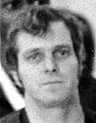
Ellis Wayne Felker
Murderer ? John Kogut
Murderer ? · USA · 1984
John Kogut was a 21-year-old high school dropout and unemployed landscaper. In…
1 victim
John Kogut
Murderer ? · USA · 1984
John Kogut was a 21-year-old high school dropout and unemployed landscaper. In…
1 victim
 Joseph Amrine
Murderer ? · USA · 1985
Joseph Amrine was a death row inmate in Missouri. He was housed with the victim…
1 victim
Joseph Amrine
Murderer ? · USA · 1985
Joseph Amrine was a death row inmate in Missouri. He was housed with the victim…
1 victim
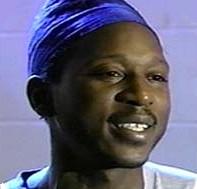 Larry Griffin
Murderer ? · USA · 1980
Larry Griffin — defendant; executed in Missouri on June 21, 1995 · Quintin Moss…
1 victim
Larry Griffin
Murderer ? · USA · 1980
Larry Griffin — defendant; executed in Missouri on June 21, 1995 · Quintin Moss…
1 victim
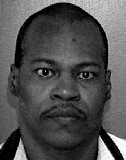 Lendell Hunter
Murderer ? · USA · 1975
Lendell Hunter carried out a string of violent rapes that shocked Augusta, Geor…
1 victim
Lendell Hunter
Murderer ? · USA · 1975
Lendell Hunter carried out a string of violent rapes that shocked Augusta, Geor…
1 victim
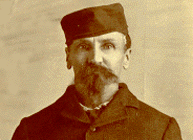 Alfred Packer
Murderer ? · USA · 1874
Alfred Packer was convicted of cannibalism after killing and eating five compan…
5 victims
Alfred Packer
Murderer ? · USA · 1874
Alfred Packer was convicted of cannibalism after killing and eating five compan…
5 victims
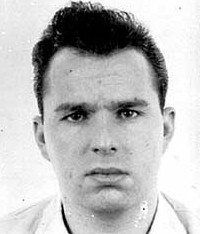 Gary Krist
Murderer ? · USA · 1959
Gary Krist Gary Steven Krist (born April 29, 1945) lived part of his childhood…
4 victims
Gary Krist
Murderer ? · USA · 1959
Gary Krist Gary Steven Krist (born April 29, 1945) lived part of his childhood…
4 victims
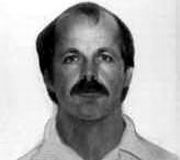 Christopher Wilder
Serial killer · USA · 1984
Christopher Bernard Wilder (March 13, 1945 – April 13, 1984) was a serial kille…
8 victims
Christopher Wilder
Serial killer · USA · 1984
Christopher Bernard Wilder (March 13, 1945 – April 13, 1984) was a serial kille…
8 victims
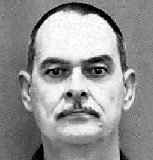 Larry Romine
Murderer · USA · 1981
Larry Romine, 45, was convicted for the shotgun slayings of his parents, Roy Le…
2 victims
Larry Romine
Murderer · USA · 1981
Larry Romine, 45, was convicted for the shotgun slayings of his parents, Roy Le…
2 victims
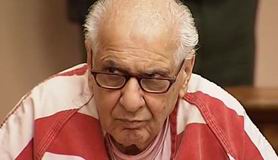 Joseph Naso
Serial killer · USA · 1977
Joseph Naso was convicted by a Marin County jury of the murders of four women d…
4 victims
Joseph Naso
Serial killer · USA · 1977
Joseph Naso was convicted by a Marin County jury of the murders of four women d…
4 victims
 Anders Behring Breivik
Mass murderer · Norway · 2011
Anders Behring Breivik (born 13 February 1979) was the perpetrator of the 2011…
77 victims
Anders Behring Breivik
Mass murderer · Norway · 2011
Anders Behring Breivik (born 13 February 1979) was the perpetrator of the 2011…
77 victims
- Gender
- male
- Country
- USA
- Location
- Houston County, Georgia, USA
- Date of birth
- 1948
- Age at first offence
- 33
- Characteristics
- robbery, rape
- Victim profile
- Evelyn Joy Ludlum (female, 19)
- Method of murder
- Strangulation
- Date(s) of murder
- November 23, 1981
- Years active
- 1981
- Date of arrest
- —
- Status
-
Executed
Executed by electrocution in Georgia on November 15, 1996
Overview
Ellis Wayne Felker (c. 1948 – November 15, 1996) was convicted of murder and related offenses in Georgia and was sentenced to death. He was executed in Georgia by electrocution on November 15, 1996 at the age of 48. Grave doubts concerning his guilt were expressed.
Timeline
- Late in the morning of December 8, 1981 — The body of 19-year-old Evelyn Joy Ludlam was found floating in Scuffle Creek in Twiggs County near a bridge on the “Cochran short route.”
- November 23, 1981 (between 11:00 and 11:30 p.m.) — Wayne Felker visited the lounge where Joy Ludlam worked.
- Tuesday evening (between 6:30 and 7:30 p.m.) — Guy Starling noticed an automobile parked in the Trust Company Bank parking lot that did not belong to bank employees.
- Wednesday evening (approximately 5:30 p.m.) — Two officers visited Felker after Joy Ludlam’s disappearance.
- February 4, 1982 — Joy Ludlam’s body was exhumed; tissue samples were taken.
- February 16, 1982 — A hunter found Joy Ludlam’s purse on the north side of Highway 96 near the Houston–Twiggs county line.
- October 3, 1976 — A 1976 incident involving Jane W. occurred.
- November 24, 1981 — Felker testified that Joy Ludlam made a telephone call from his residence at about 6:00 p.m. (as part of his account of last seeing her).
- May 2, 1996 — Relief was denied in connection with a federal filing seeking an order permitting a second petition for federal habeas relief.
- June 28, 1996 — The Superior Court set September 10 through September 17, 1996 as the period during which Felker’s execution would be carried out.
- August 30, 1996 — The Superior Court of Houston County, Georgia set September 10 through September 17, 1996 as the period during which Felker’s execution would be carried out.
- September 10, 1996 — Felker applied to the United States Supreme Court for a stay.
- September 10, 1996 — Felker’s execution was not carried out on September 10 because a stay was obtained from the Houston County Superior Court.
- September 2, 1996 — Felker filed a mandamus petition in the Georgia Supreme Court seeking to compel the Houston County Superior Court to rule on an Open Records Act lawsuit.
- September 5, 1996 — Felker filed a petition for writ of habeas corpus in the Superior Court of Butts County, Georgia.
- September 6, 1996 — The Superior Court denied that petition.
- September 6, 1996 — The Georgia Supreme Court entered an order requiring the Houston County Superior Court to consider and rule within 48 hours.
- September 8, 1996 — The Houston County Superior Court held a hearing on Felker’s Open Records Act lawsuit.
- September 9, 1996 — The Georgia Supreme Court denied Felker’s application for a certificate of probable cause to appeal the denial and denied his motion for a stay of execution.
- September 9, 1996 — The Superior Court stayed Felker’s execution until 2:00 p.m. ET, September 12, 1996.
- September 10, 1996 — The Superior Court extended the stay of execution until 2:00 p.m. ET, September 14, 1996.
- September 12, 1996 — The Superior Court denied Felker’s motion for summary judgment on his Open Records Act claim, denied his motion to withdraw the pending execution warrant, and denied his motion for an additional stay of execution.
- September 12, 1996 — The Superior Court stayed execution for forty days and directed the Houston County Superior Court to make findings of fact and conclusions of law regarding Felker’s Open Records Act lawsuit.
- September 14, 1996 (2:00 p.m. ET) — The execution was rescheduled for 3:00 p.m. ET, September 14, 1996.
- September 23, 1996 — The Houston County Superior Court entered written findings of fact and conclusions of law concluding the district attorney had complied with Felker’s Open Records Act request.
- October 28, 1996 — Felker filed a motion with the Georgia Supreme Court for a stay of execution.
- October 30, 1996 — The Georgia Supreme Court affirmed the Houston County Superior Court with respect to the Open Records Act lawsuit and denied Felker’s motion for a stay.
- November 8, 1996 — Felker, acting jointly with another Georgia death row inmate, Larry Lonchar, filed a motion for a preliminary injunction and complaint under 42 U.S.C. 1983 in the United States District Court for the Middle District of Georgia.
- November 11, 1996 — Felker filed his fourth state habeas petition, together with a motion for a stay of execution, in the Butts County Superior Court.
- November 12, 1996 — The district court denied Felker’s motion for a preliminary injunction and denied his request for declaratory and injunctive relief.
- November 12, 1996 — Felker applied to the Georgia Supreme Court for a stay of execution and for a certificate of probable cause to appeal the denial of his fourth habeas petition.
- November 13, 1996 — Another panel of the United States Court of Appeals affirmed the denial of declaratory and injunctive relief.
- November 14, 1996 — The Supreme Court of the United States denied Felker’s petition for a writ of certiorari and his motion for a stay of execution.
- November 14, 1996 — The Georgia Supreme Court denied all requested relief.
- November 14, 1996 (afternoon) — Felker filed in the United States District Court for the Middle District of Georgia a motion under Federal Rule of Civil Procedure 60(b)(1), (2), (3), and (6) for relief from the January 26, 1994 judgment denying his 28 U.S.C. 2254 petition, and filed a motion for a stay of execution.
- November 15, 1996 — Felker was executed by electrocution in Georgia’s electric chair.
Background
Ellis Wayne Felker had been convicted in 1976 of aggravated sodomy and served twelve years for that sentence. He was paroled in 1980 after serving four years of a twelve-year sentence. He opened a leather shop in April 1981 shortly after his release from prison. Felker had a romance with Patricia Woods after opening his business, and Felker attributed disinterest in the business to that relationship.
The offence
Victim
Evelyn Joy Ludlam was a 19-year-old student at Macon Junior College and a cocktail waitress at the Holiday Inn in Warner Robins.
Disappearance and discovery
Joy Ludlam disappeared for two weeks. Her body was found floating in Scuffle Creek in Twiggs County near a bridge on the “Cochran short route.” At the time of discovery, she was wearing a plaid coat and a red dress consistent with the clothing she had been wearing when last seen alive.
Autopsy findings and death determination
Warren Tillman, a medical examiner with the state crime lab, observed that pantyhose and underwear remained on the body, but the crotch of each had been ripped out. Tillman described whitish lines of material around the eyes and mouth that appeared to be an adhesive substance, hemorrhaging inside the eyelids indicative of asphyxiation, and contusions at the junction of the lips indicative of force against her mouth. He noted bruising on the neck and ecchymotic hemorrhage on the breasts consistent with suction. Bruise marks were observed on the left shoulder and right thigh, and marks on the left wrist and on the ankles consistent with binding. Tillman observed areas of contusion around the vagina and anus, which were distended, indicating traumatic entry. He found hemorrhage near the second left rib without associated surface bruising consistent with force applied by an object such as a fist or a foot, and areas of subgaleal hemorrhage inside the scalp. There was no evidence of brain hemorrhage.
Tillman concluded the cause of death was asphyxiation from strangulation. Establishing a time of death proved difficult due to decomposition and immersion. Tillman’s original estimate was that Joy had been dead 3 to 5 days, or possibly longer, and he concluded she had been dead at least three to five days and could have been dead for two weeks after receiving information regarding air temperature and reviewing other case histories.
Dr. James Whitaker, medical examiner for Houston County, microscopically examined tissue samples taken from bruised areas after exhumation and concluded the bruises had been inflicted within 4 to 6 hours prior to death.
Counts and verdict at trial
Felker was charged in Houston County with murder, robbery, rape, aggravated sodomy, and false imprisonment. At trial, a verdict of not guilty was directed on the robbery count, and a jury convicted Felker on the remaining counts. He was sentenced to death for the murder. The convictions were affirmed on appeal (“We affirm.”).
Evidence relating to the offence
A notebook opened to a page written in Joy Ludlam’s handwriting stated: “I'm going to Atlanta to eat dinner with Wayne and some of his friends. They are GS-11's on base. Joy.”
Fibers found on Joy’s coat were consistent with fibers present in a yellow and orange blanket first observed in Felker’s home and later retrieved by police from his parents. Similar fibers were found in the hatchback area of Felker’s automobile. Hairs were found on Joy’s clothes including her underclothes and on her body similar to Felker’s head and beard hair. Hairs adhering to two handkerchiefs in Joy’s pocketbook were similar to Felker’s head hair, and additional hairs discovered in the bedroom of Felker’s home were similar to Joy’s head and pubic hair.
Investigation
A police investigation included searches and collection of hairs and fibers between December 8, 1981, and March 29, 1982. Authorities searched Felker’s house and car several times, collected hairs and fibers, and compared them with hairs and fibers found on Joy Ludlam’s body. A purse containing a “Mickey Mouse” pendant was found on February 16, 1982; the necklace itself was never found.
Investigators also addressed the difficulty of determining time of death given immersion in water and decomposition, and relied on information about air temperature and other case histories involving bodies immersed in water.
Felker’s house and car were searched multiple times, and warrants were issued for searches of Felker’s automobile, home, and his leather shop; warrants also addressed seizure for hair comparison.
Arrest
Felker was under police surveillance for 2 weeks. Two officers visited Felker on Wednesday evening at approximately 5:30 p.m. during the investigation.
Trial
Hypnosis-related proceedings
Before trial, two witnesses were hypnotized to aid recall of certain events. One witness was the assistant manager of the Holiday Inn lounge on November 23, 1981; the witness recalled without hypnosis seeing Felker and observing a casual conversation with Joy Ludlam, and no additional memories were uncovered by hypnosis. The other witness was a police officer who talked to Felker on November 25, 1981; the officer’s testimony concerned whether Felker admitted calling the Holiday Inn or only calling from his residence.
Admission of prior conduct evidence
Evidence of a 1976 incident involving bondage and forcible sex was admitted at trial. The Georgia Supreme Court found the extrinsic offenses were “so nearly identical in method as to earmark them as the handiwork of the accused.” The court described a distinctive modus operandi and noted similarities including the victims as young, white females employed as cocktail waitresses, lured by deceitful means, separation from automobiles, victims bound at ankles and wrists, duct tape over mouth and eyes in one case, adhesive lines on Joy Ludlam’s face visible in photographs, bruising patterns, choking, beating, tearing of underclothes, sexual abuse, and removal of chain necklaces with pendants later found in pocketbooks while necklaces disappeared.
District attorney testimony and evidence handling controversies (as described)
Grave doubts concerning Felker’s guilt included assertions that prosecutors had illegally withheld boxes of evidence, including possible DNA samples and a signed confession made by another suspect who was mentally retarded. The presiding judge at one of Felker’s hearings stated that Felker’s right to a fair trial had been severely compromised. The District Attorney in charge denied under oath that such evidence existed.
Defense testimony
Felker testified regarding the 1976 incident, asserting he was lost and asking directions to a party on Navarro Drive and claimed that the sex in that incident was consensual. On cross-examination, Felker admitted he might have inflicted bruising and that he “might have gotten too rough.” He admitted removing Jane W.’s necklace but did not know why and could not explain how the pendant wound up in her purse absent its necklace. Felker testified that he taped her mouth because she “was giggling,” did not recall why he taped her eyes, and did not know why he tied her up before removing her clothes. He also testified regarding the Joy Ludlam disappearance and claimed he last saw her at approximately 6:00 p.m. on November 24, 1981.
Felker’s testimony included details that Joy made a telephone call while he changed clothes and that Joy seemed to be in a hurry, but he unloaded items from his car before leaving. He testified that a leather shop catalog was taken by Joy but no such catalog was discovered in the search of Joy’s car two days later.
Felker also testified that after leaving his house twice that night—once to purchase beer and cigarettes and later to “drive around looking for Pat [Woods]”—he was unable to find Pat Woods in a yard and returned home alone. Felker answered when asked by the district attorney how he expected to find Pat Woods that he was “[h]oping she'd be in a yard somewhere.” Felker denied the trip’s purpose was to dispose of Joy Ludlam’s body.
Quotations in the trial-related material
Jane W., who was the victim in the 1976 incident, testified to Felker’s statement and conduct in court, including the testimony that Felker “was so nice . . ., he acted so lost . . ., [he] sounded so convincing . . . [that] I unlocked the door [and] he got in the car.”
In the 1976 incident testimony, Felker asked in effect whether the victim had ever been anally sodomized. When she did not answer because she was gagged, Felker punched her on her right thigh with his fist, pounded her on her chest, and said, “I'm talking to you.”
In the 1981 case narrative, a notebook contained the statement: “I'm going to Atlanta to eat dinner with Wayne and some of his friends. They are GS-11's on base. Joy.”
Sentencing
At sentencing, the jury found two statutory aggravating circumstances: (1) the murder was committed while Felker was engaged in another capital felony, to wit: rape; and (2) the offense was outrageously or wantonly vile, horrible or inhuman in that it involved torture or depravity of mind. Felker was sentenced to death for the murder.
Appeals
On direct appeal, the Georgia Supreme Court affirmed Felker’s conviction and death sentence (“We affirm.”). The decision references “FELKER v. THE STATE. 40350. ( 252 Ga. 351 ) ( 314 SE2d 621 ) DECIDED MARCH 15, 1984 -- REHEARING DENIED MARCH 29, 1984.”
Federal habeas corpus proceedings were pursued. In a federal appeal, the United States Court of Appeals for the Eleventh Circuit affirmed the denial of habeas relief, finding “no merit in any” of Felker’s contentions. Felker also filed subsequent motions and applications, including petitions and motions related to Rule 60(b), habeas corpus restrictions under 28 U.S.C. § 2244(b), and requests for certificates of probable cause or certificates of appealability. Those applications were denied.
In Georgia proceedings related to the Open Records Act, execution was stayed and rescheduled multiple times. The Georgia Supreme Court denied a motion for a stay at certain points and later denied relief on November 14, 1996.
Outcome
The Supreme Court of Georgia refused to order a new trial or grant a stay long enough to sort through withheld paperwork in the case. The final stay was granted by the Supreme Court on November 14, 1996, and the unanimous decision denying the appeal was issued late the next day after a “leisurely” lunch. The electrocution occurred a few hours later, with Felker declared dead at 7:39 p.m. Felker declined to make a final statement, but left a taped message for his family and girlfriend. “He stated he was innocent and said the state was putting an innocent man to death,'' said Mike Light, a Corrections spokesman.
In 2000, a Georgia judge ruled that DNA testing would be performed in an attempt to exonerate an executed person in the United States; the results were ruled as inconclusive.
Other details
Victim’s employment and residence
Joy Ludlam was a student at Macon Junior College and worked as a cocktail waitress at the Holiday Inn in Warner Robins. Her parents were residents of Macon, and Joy moved about 10 months prior to her death to live in Warner Robins with an older woman whom Joy had met through church. She had begun to seek other employment prior to her death due to religious beliefs not allowing her to work Friday nights or Saturdays.
People mentioned in the offence narrative
- Patricia Woods — Felker’s cohabiting partner; left Felker the previous Saturday after he blackened both of her eyes; later cohabited again with Felker.
- Irma Anthony — Joy’s cohabiting companion; spent Tuesday night at the hospital with her mother.
- Ms. Akins — a visitor who testified about Joy’s telephone call and Joy leaving wearing a long plaid coat.
- Guy Starling — office manager of Trust Company Bank; noticed the automobile parked in the bank’s parking lot.
- Warren Tillman — medical examiner with the state crime lab who observed autopsy findings.
- Dr. James Whitaker — medical examiner for Houston County who examined tissue samples after exhumation.
- Dr. Larry Howard — examined the body after it was exhumed (as referenced in the appeal discussion).
- Dr. Joseph Burton — chief medical examiner for Fulton and DeKalb counties, used in discussions of death timing.
- Felker’s neighbor (name not provided) and Felker’s mother and other neighbors involved in keeping track of cars.
- Jane W. — victim in the 1976 incident described at trial (named as “Jane W.” in the material).
- Mike Mears — referenced as an attorney involved in appeals.
- Michael Bowers — Attorney General of Georgia, quoted in the material.
- Amnesty International — quoted urging implementation of a full investigation and non-opposition to legal appeals.
Quotation involving the Attorney General
When asked specifically about the Felker case, Michael Bowers replied : “I've talked to the cops who investigated him, and I asked them: Guys, is there any doubt about his guilt? And they told me, Bullshit .”
Elections and scheduling related details
Felker’s execution was delayed during the Summer Olympics in Atlanta and he was eventually executed on November 15, 1996 at age 48. A prior execution bid was stayed less than 30 minutes before it was scheduled in September 1996 after discovery of five crates of police notes and evidence withheld from defense attorneys at the original trial.
Spotted an error, or have more information about this case?