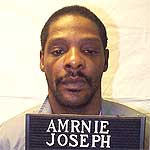
Joseph Amrine
Murderer ? Lamont Underwood
Murderer ? · USA · 1994
Lamont Claxton Underwood, known as “L.C.,” was a former Salisbury policeman. Pr…
2 victims
Lamont Underwood
Murderer ? · USA · 1994
Lamont Claxton Underwood, known as “L.C.,” was a former Salisbury policeman. Pr…
2 victims
 Ellis Wayne Felker
Murderer ? · USA · 1981
Ellis Wayne Felker (c. 1948 – November 15, 1996) was convicted of murder and re…
1 victim
Ellis Wayne Felker
Murderer ? · USA · 1981
Ellis Wayne Felker (c. 1948 – November 15, 1996) was convicted of murder and re…
1 victim
 John Kogut
Murderer ? · USA · 1984
John Kogut was a 21-year-old high school dropout and unemployed landscaper. In…
1 victim
John Kogut
Murderer ? · USA · 1984
John Kogut was a 21-year-old high school dropout and unemployed landscaper. In…
1 victim
 Larry Griffin
Murderer ? · USA · 1980
Larry Griffin — defendant; executed in Missouri on June 21, 1995 · Quintin Moss…
1 victim
Larry Griffin
Murderer ? · USA · 1980
Larry Griffin — defendant; executed in Missouri on June 21, 1995 · Quintin Moss…
1 victim
 Lemuel Prion
Murderer ? · USA · 1992
October 24, 1992 — The arms of the 21-year-old female victim were discovered in…
1 victim
Lemuel Prion
Murderer ? · USA · 1992
October 24, 1992 — The arms of the 21-year-old female victim were discovered in…
1 victim
 Lendell Hunter
Murderer ? · USA · 1975
Lendell Hunter carried out a string of violent rapes that shocked Augusta, Geor…
1 victim
Lendell Hunter
Murderer ? · USA · 1975
Lendell Hunter carried out a string of violent rapes that shocked Augusta, Geor…
1 victim
 Edmund Lopes
Murderer · USA · 1966
Edmund Lopes was a Baptist minister. After being sentenced for murdering his wi…
2 victims
Edmund Lopes
Murderer · USA · 1966
Edmund Lopes was a Baptist minister. After being sentenced for murdering his wi…
2 victims
 William Hamilton Little
Murderer · USA · 1983
December 3, 1983 — Michael John Rammel found the body of Marilyn Peter in her h…
1 victim
William Hamilton Little
Murderer · USA · 1983
December 3, 1983 — Michael John Rammel found the body of Marilyn Peter in her h…
1 victim
 Henri-Antoine Charrière
Homicide · France · 1930
Henri-Antoine Charrière was born in Ardèche, France. He had two older sisters.…
1 victim
Henri-Antoine Charrière
Homicide · France · 1930
Henri-Antoine Charrière was born in Ardèche, France. He had two older sisters.…
1 victim
 Marlon Howell
Murderer · USA · 2000
Name: Marlon Howell Status: Sentenced to death on March 30, 2001 · May 15, 2000…
1 victim
Marlon Howell
Murderer · USA · 2000
Name: Marlon Howell Status: Sentenced to death on March 30, 2001 · May 15, 2000…
1 victim
 Leonard Eugene Rojas
Murderer · USA · 1994
Leonard Uresti Rojas lived in Alvarado, Texas, with his common-law wife/girlfri…
2 victims
Leonard Eugene Rojas
Murderer · USA · 1994
Leonard Uresti Rojas lived in Alvarado, Texas, with his common-law wife/girlfri…
2 victims
- Gender
- male
- Country
- USA
- Location
- Missouri, USA
- Date of birth
- ???
- Characteristics
- abuse, rape
- Victim profile
- Gary "Fox" Barber (fellow inmate)
- Method of murder
- St abbing with homemade knife
- Date(s) of murder
- October 18, 1985
- Years active
- 1985
- Date of arrest
- Same day
- Status
-
Released
Sentenced to death; conviction overturned; released on July 28, 2003
Background
Joseph Amrine was a death row inmate in Missouri. He was housed with the victim, Gary Barber, in the special management unit or “supermax” area of the penitentiary (Missouri State Penitentiary) during October of 1985. In early October, Amrine became aware of “rumors” being circulated by Barber concerning an illegal incident in which Barber committed a homosexual act upon Amrine when they were cell mates in the “general population” area of the penitentiary.
The offence
In the recreation-room incident, Amrine stabbed Gary Barber in the back behind the shoulder blade. Amrine then ran, and Barber removed the knife and chased Amrine toward the front of the room. Barber then stated, “Joe, I’m going to get you,” dropped the weapon, and collapsed not far from Officer Noble. Shortly thereafter, Barber died as a result of the stab wound.
Investigation
Inmate Randy Ferguson testified that on October 3 he overheard a conversation between Amrine and Joe Moore during which Moore commented “if somebody had treated him like that or done something like that to him, he would kill him”. Amrine replied “Don’t think that ain’t what I plan to do”.
Ferguson also testified that on October 7 Amrine informed him and three other inmates that he planned to stab Barber the next day and wanted them to “block.”
Inmate Terry Russell testified that Amrine told him that he intended to “stick” Barber when the inmates went to the “yard”; however, that opportunity did not arise.
Ferguson described that on the morning of October 8 Amrine confronted Barber about the rumors. After some discussion, Amrine and Barber came to where Russell was standing. Amrine asked Russell to repeat the accusations in front of Barber, and Russell stated that Barber “was going around telling people he had sex with Amrine,” to which Barber did not respond. Amrine said “okay” and walked away, but a fight broke out between Russell and Barber as a result of the allegations and they were placed in detention until October 18.
Ferguson further testified that on the evening of October 17, 1985, the night before Barber and Russell were released from detention, he overheard a conversation between inmates Omar Hutchison, Daryl Saddler and Clifford Valentine concerning a knife and observed Saddler go up to the floor above them and pass a knife down to Hutchison.
Following lunch on October 18, inmates from Amrine’s unit were released to the multipurpose room for recreation. Two guards, Officers Thomas Smith and John Noble, were on duty supervising the 45 to 50 inmates in the room that day. The doors to the recreation room were locked and the inmates could enter and exit only through the front door, guarded by Officer Noble.
Ferguson testified that when he arrived at the multipurpose room, he began working out on a punching bag and saw Hutchison enter the room, approach the window, remove an ice-pick type weapon from his waistband, and tape the weapon to the outside of the building. Ferguson later saw Amrine go to the window and retrieve the knife, which he placed in the waistband of his pants.
Ferguson testified that Amrine approached Barber, who was sitting alone in the corner of the room, knelt down and started a conversation. The two men got up and began pacing around the room, during which time Amrine placed his arm around Barber’s shoulder. Amrine subsequently took his arm off Barber’s shoulder, pulled the knife from his waistband and stabbed Barber in the back behind the shoulder blade. Amrine turned and ran while Barber removed the knife and chased Amrine toward the front of the room.
The stabbing was witnessed by Ferguson and inmate Jerry Poe, both of whom identified Amrine as Barber’s killer.
Arrest
No arrest information was provided in the case record.
Trial
Joseph Amrine was sentenced to death in 1986 for the fatal stabbing of fellow prisoner Gary Barber on Oct. 18, 1985, in a recreation room at the state prison in Jefferson City.
The prosecution’s case relied on circumstantial and conflicting evidence. The state failed to link Amrine to the scene through physical evidence and instead presented three inmates who maintained they saw Amrine stab Barber, all with inconsistent statements in their depositions. The first inmate to come forward, Terry Russell, was identified as a suspect by corrections officer John Noble.
During the murder trial, multiple inmates stated that Amrine was elsewhere playing cards at the time of the killing, and the state presented testimony against him despite this.
The case record stated that Amrine was unable to win an acquittal at trial even with a solid alibi and unreliable evidence against him. It also stated that Amrine’s state-appointed counsel failed to present mitigating evidence, did not impeach witnesses with prior inconsistent statements, and did not object to false testimony regarding a prior alleged stabbing by Amrine.
The case record stated that after hearing the actual trial, the jury foreman later admitted the jury “didn’t have much trouble deciding that Mr. Amrine was guilty” after hearing the actual trial.
Sentencing
On October 30, 1986, the jury convicted Amrine of murder and sentenced him to death.
Appeals
A post-conviction hearing in 1989 addressed recantations by Amrine’s accusers.
The case record stated that two of Amrine’s three accusers—Terry Russell and Randall Ferguson—recanted their testimony at a post-conviction hearing in 1989, and that the third accuser, Jerry Poe, recanted his in 1997.
It stated that all three later admitted in letters, videotaped depositions, and signed affidavits that they lied due to threats and promises by the authorities or fear of rape and violence from other inmates.
It further stated that at a 1998 federal district court hearing, Russell admitted he lied to deflect suspicion of the murder away from himself.
The case record stated that even as these recantations became known, Amrine’s four appeals and his application for pardon to Missouri Governor Bob Holden were denied.
Before 1997, appeals courts claimed that although other accusers had recanted, Poe’s testimony still implicated Amrine, and that after Poe recanted, courts maintained that his retraction could not be relied upon.
The case record stated that by 2003, Amrine’s appellate counsel, Sean O’Brien and Kent Gipson, made significant progress in obtaining justice for their client. It stated that the state actively sought an execution date.
Assistant Attorney General Frank Jung argued that the Supreme Court had no jurisdiction because there was no constitutional violation during Amrine’s first trial, and that Jung urged the court to execute Amrine even if it found him to be innocent.
The Supreme Court of Missouri overturned Amrine’s conviction in a 4-3 decision.
Judge Richard Teitelman wrote the opinion for the majority, and Judges Ronnie White, Laura Denvir Stith and Michael Wolff joined. The record stated that Judges Benton and Judge Price wrote dissenting opinions.
The case record included a statement by Teitelman emphasizing the absence of credible evidence remaining from the first trial to support the conviction and cited the standard of “actual innocence” as described by the majority.
The record included the following quoted language from Teitelman:
“It is difficult to imagine a more manifestly unjust and unconstitutional result than permitting the execution of an innocent person.”
After two months following the conviction being overturned, local prosecutor Bill Tacket filed new murder charges against Amrine in June 2003. One month later, Tacket announced he would no longer seek a new trial, noting there was absolutely no evidence to implicate Amrine.
Outcome
Timeline
- October 3, 1985 — Ferguson overheard a conversation between Amrine and Joe Moore in which Moore said “if somebody had treated him like that or done something like that to him, he would kill him,” and Amrine replied “Don’t think that ain’t what I plan to do”.
- October 7, 1985 — Amrine told Ferguson and three other inmates that he planned to stab Barber the next day and wanted them to “block.”
- October 8, 1985 — Amrine confronted Barber about the rumors; Amrine asked Russell to repeat the accusation; Russell stated Barber “was going around telling people he had sex with Amrine,” and Amrine said “okay,” after which a fight broke out between Russell and Barber.
- October 17, 1985 — Ferguson overheard a conversation between Omar Hutchison, Daryl Saddler and Clifford Valentine about a knife and observed Saddler pass a knife down to Hutchison.
- October 18, 1985 — In the multipurpose room recreation setting at the Missouri State Penitentiary, Amrine retrieved the knife from the window area and stabbed Gary Barber; Barber chased Amrine after removing the knife and stated “Joe, I’m going to get you” before collapsing and dying from the stab wound.
- October 30, 1986 — The jury convicted Amrine of murder and sentenced him to death.
- April 29, 2003 — The Supreme Court of Missouri ordered that Amrine be conditionally discharged 30 days from the date the mandate issues unless the state elects to file new charges in relation to the murder of which he was convicted.
- June 2003 — Bill Tacket filed new murder charges against Amrine.
- July 28, 2003 — Joseph Amrine was released from jail.
The case record stated that the Supreme Court of Missouri handed down its decision in State ex rel. Joseph Amrine v. Donald P. Roper, a habeas proceeding based on claims of actual innocence. It included that in a 4-3 decision written by Judge Teitelman, the Court ordered that Amrine be conditionally discharged 30 days from the date the mandate issues unless the state elected to file new charges against Amrine in relation to the murder of which he was convicted. Judge Wolff wrote a concurring opinion, and Judge Benton and Judge Price wrote dissenting opinions.
The case record stated that the Cole County prosecutor announced he would not retry Amrine in the death of a former state prison inmate. It also stated that three former inmates who initially testified against Amrine recanted their statements.
It stated that the Missouri Supreme Court overturned Amrine’s conviction and that the court said Amrine had shown “clear and convincing evidence of actual innocence that undermines confidence” in his conviction.
The case record stated that the mandate will not be issued until it is determined whether the Supreme Court will rehear the case, and it noted that the attorney general’s office had 15 days to decide whether it would ask for a rehearing.
The record quoted Amrine’s attorney Sean O’Brien calling the decision “a huge step in the right direction because it puts Joe back at square one. Hopefully, saner minds will prevail here” and stated that O’Brien also said: “I'm thrilled and Joe was thrilled,” and that “He alternatively laughed and cried,” when O’Brien told him of the decision.
The record stated that a local prosecutor announced on July 28, 2003 that he would not seek a new trial, and that Amrine was released from prison that day.
It stated that Amrine was charged, convicted and sentenced to death for the murder of fellow inmate Gary “Fox” Barber while serving a prison sentence for robbery, burglary and forgery.
It also stated that three months after the Supreme Court’s decision, Bill Tacket filed new murder charges against Amrine and later decided not to seek a new trial based on new DNA tests, with the record stating that DNA tests ordered by Tacket did not implicate Joe.
The case record stated that “Joseph Amrine is Released” and described his release as the 109th person released from sentence of death in the United States for reasons of probable innocence.
Other details
The case record included a statement that Members of Missourians to Abolish the Death Penalty (MADP) celebrated Amrine’s release and condemned the lengthy process to win his release, and called for a moratorium on executions. It also stated that, in November 2001, Attorney General Jay Nixon asked the Missouri Supreme Court to set an execution date for Amrine and that the court complied with several requests for such dates for others, while delaying setting a date for Amrine and convening an extraordinary hearing to consider his innocence.
It stated that the case included a documentary titled “Unreasonable Doubt: the Joe Amrine Case” and that public attention may have influenced the extraordinary hearing.
It included a quote attributed to Sean O’Brien:
“It was way too easy to convict him in the first place, and way too hard to get him a new trial.”
The case record stated that Amrine spent 17 years on death row and that he was freed on July 28, 2003 after spending almost two decades on death row for a crime he did not commit.
It stated that just before his sentence was overturned, Amrine had chosen the song “I Feel Like Going Home” for his funeral, and it included his quoted statement: “That's how I felt,” and then “like going home.”
The case record stated that in 1989, two of Amrine’s accusers recanted and that the third accuser recanted in 1997.
It also stated that Amrine would have left jail a free man in 1992 had he not been wrongly convicted for Barber’s murder.


Spotted an error, or have more information about this case?