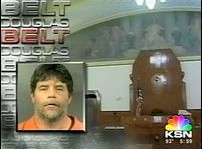
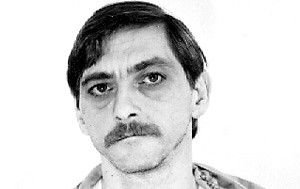
Douglas Belt
Murderer Robert Martines Perez
Murderer · USA · 1994
Name: Robert Martines Perez · Other name used in proceedings: Robert Martinez P…
15 victims
Robert Martines Perez
Murderer · USA · 1994
Name: Robert Martines Perez · Other name used in proceedings: Robert Martinez P…
15 victims
 Billy Frank Vickers
Murderer · USA · 1993
Billy Frank Vickers Vickers was executed by lethal injection in Texas on Januar…
14 victims
Billy Frank Vickers
Murderer · USA · 1993
Billy Frank Vickers Vickers was executed by lethal injection in Texas on Januar…
14 victims
 Bobby Joe Mayes
Murderer · USA · 1998
Name: Bobby Joe Mayes · Court: Supreme Court of Missouri (case number SC82743)…
2 victims
Bobby Joe Mayes
Murderer · USA · 1998
Name: Bobby Joe Mayes · Court: Supreme Court of Missouri (case number SC82743)…
2 victims
 Todd Hall
Homicide · USA · 1996
Todd Hall was described by neighbors as "mentally slow" and was said to have su…
9 victims
Todd Hall
Homicide · USA · 1996
Todd Hall was described by neighbors as "mentally slow" and was said to have su…
9 victims
 Kenneth Mosley
Murderer · USA · 1997
Kenneth Mosley was convicted of capital murder and was executed by lethal injec…
1 victim
Kenneth Mosley
Murderer · USA · 1997
Kenneth Mosley was convicted of capital murder and was executed by lethal injec…
1 victim
 Damien Echols
Murderer · USA · 1993
Damien Wayne Echols was one of the three men known as the West Memphis Three. H…
3 victims
Damien Echols
Murderer · USA · 1993
Damien Wayne Echols was one of the three men known as the West Memphis Three. H…
3 victims
 Eric Christopher Payne
Murderer · USA · 1997
Eric Christopher Payne v. Commonwealth of Virginia (Record No. 980559); Eric Ch…
2 victims
Eric Christopher Payne
Murderer · USA · 1997
Eric Christopher Payne v. Commonwealth of Virginia (Record No. 980559); Eric Ch…
2 victims
- Gender
- male
- Country
- USA
- Location
- Sedgwick County, Kansas, USA
- Date of birth
- 1962
- Age at first offence
- 40
- Characteristics
- serial rapist, truck driver, arson
- Victim profile
- Lucille Gallegos, 43
- Method of murder
- B eheading
- Date(s) of murder
- June 24, 2002
- Years active
- 2002
- Date of arrest
- —
- Status
-
Sentenced to death
Sentenced to death in 2004
Case information
Name: Douglas Belt
Status and outcome
Douglas Belt was sentenced to death in 2004.
The appeal resulted in affirmance. The McPherson County dismissal could be affirmed as right for the wrong reason, and the Saline and Reno decisions to dismiss relied on the rationale that the appellate court agreed with. The appellate court held that, because it was compelled to rule against the State on the particularity of the John Doe identification in the original warrants, the State’s second issue regarding official negligence and the speedy trial right was moot. The court therefore “Affirmed.”
Charges and case filing
A case involving charges under K.S.A. 1993 Supp. was filed on July 1, 1997.
The filed charges were:
- 3 Supp. 21-3502(a)(1)(A)
- two counts of aggravated burglary, K.S.A. 1993 Supp. 21-3716
- two counts of aggravated kidnapping, K.S.A. 1993 Supp. 21-3421
- five counts of aggravated criminal sodomy, K.S.A. 1993 Supp. 21-3506(a)(3)
- one count of theft, K.S.A. 1993 Supp. 21-3701(a)(1)
Timeline
- July 1, 1997 — The charges described under K.S.A. 1993 Supp. were filed.
Legal issues on appeal and governing law
Statute of limitations framework
The court determined that the case was “well outside the 2-year statute of limitations for theft and burglary,” citing K.S.A. 1993 Supp. 21-3106(5).
The court further explained that, even if the John Doe warrant gave an adequate description of Belt, “the only charges remaining for prosecution would be”:
- the two counts of rape
- the five counts of aggravated criminal sodomy
- the two counts of aggravated kidnapping
The court stated that each of those categories is governed by a 5-year limitations period, citing K.S.A. 1993 Supp. 21-3106(4).
The primary issue on appeal was whether Judges Boyer and Becker erred in ruling that the John Doe warrants failed to identify Belt sufficiently to toll the applicable statutes of limitations. Belt’s cross-appeal argument focused on Judge Walker’s ruling against him on the same point. The competing arguments were considered together.
Warrant particularity standards
The court cited the Fourth Amendment to the United States Constitution and K.S.A. 22-2304(1).
The Fourth Amendment was described as protecting citizens from unreasonable searches and seizures and guaranteeing that:
“no Warrants shall issue, but upon probable cause, supported by Oath or affirmation, and particularly describing the . . . [person] to be seized.”
The statute K.S.A. 22-2304(1) was described as requiring that a Kansas arrest warrant “shall contain the name of the defendant, or, if his name is unknown, any name or description by which he can be identified with reasonable certainty,” with emphasis referenced by the court.
The court noted precedent supporting the contention that a warrant need not provide the name of a suspect if it describes the suspect “sufficiently to identify” him or her, citing West v. Cabell, 153 U.S. 78, 85.
However, the State conceded that the warrants at issue contained insufficient identifying information. The court set out details as follows:
- The McPherson County warrants mentioned only “DNA loci common to all humans.”
- The Saline County warrants mentioned only “DNA loci” as well.
- The Reno County warrant referred only to a John Doe, “listing no loci.”
Whether DNA information could satisfy particularity
The State argued that references to unique DNA autoradiographs in supporting affidavits cured the warrants’ lack-of-particularity problems. The court noted that neither the United States Supreme Court nor the Kansas court had yet addressed whether a description of DNA characteristics can fulfill a warrant particularity requirement.
The parties directed the court to cases from sister jurisdictions, including:
- People v. Robinson, 156 Cal. App. 4th 508, 67 Cal. Rptr. 3d 392 (2007), rev. granted February 13, 2008, S158528
- State v. Davis, 281 Wis. 2d 118, 698 N.W.2d 823 (2005)
- State v. Dabney, 264 Wis. 2d 843, 663 N.W.2d 366 (2003), rev. denied 266 Wis. 2d 63 (2003)
The court explained that these cases support the proposition that a warrant can identify the person to be arrested for a sexual offense by describing a unique DNA profile, or by incorporating by reference an affidavit containing such a unique profile, and thereby can satisfy constitutional and statutory particularity requirements, referencing K.S.A. 22-2304.
The court stated it did not disagree with this proposition in the abstract, but held the case was different “concrete[ly].” It said that neither the John Doe warrants nor the affidavits supporting them set forth the unique DNA profile of their subject.
Insufficiency of extrinsic evidence and affidavits
The court addressed prior cases in which affidavits supplied missing information in warrants, and said they provided little persuasive authority in these circumstances. It discussed United States v. Espinosa, 827 F.2d 604 (9th Cir.), cert. denied 485 U.S. 968 (1987) and distinguished the present circumstances.
The court also discussed Kansas cases on technical irregularities and particularity, including:
- K.S.A. 22-2511 and the quoted principle that search warrants should not be quashed or evidence suppressed for technical irregularities that do not affect substantial rights of the accused.
- State v. LeFort, 248 Kan. 332, 335, 806 P.2d 986 (1991)
- State v. Holloman, 240 Kan. 589, 595-96, 731 P.2d 294 (1987)
- State v. Spaulding, 239 Kan. 439, 441, 442, 720 P.2d 1047 (1986)
- State v. Jackson, 226 Kan. 302, 304, 597 P.2d 255 (1979)
- Hearron v. State, 10 Kan. App. 2d 229, 233-34, 696 P.2d 418 (1985)
- State v. Forsyth, 2 Kan. App. 2d 44, 47, 574 P.2d 241 (1978)
- State v. Journey, 1 Kan. App. 2d 150, 151-52, 562 P.2d 138 (1977)
- Kleypas, 272 Kan. at 926-30
The court held that the infirmity was a near-complete lack of identifying information and said that there was no reason the State could not have particularly described the perpetrator’s unique DNA profile in the warrants or supporting affidavits.
The court cited United States v. Spilotro, 800 F.2d 959, 963 (9th Cir. 1986) as one factor relevant to specificity whether the government could have included particulars at the time warrant issued.
The court emphasized that genetic information was necessary as an evidentiary baseline for probable cause, and that verifying it scientifically once seized did not eliminate the need for it to be drawn in the warrant in the first place.
The court held that the affidavits’ references to “unattached, unsworn, extrinsic evidence” were insufficient to fulfill constitutional and statutory requirements and cure the defective warrants.
It cited United States v. Jarvis, 560 F.2d 494 (2d Cir. 1977), cert. denied with dissent 435 U.S. 934 (1978), describing that “John Doe” warrants without a name and description by which defendant could be identified with reasonable certainty were invalid and could not be cured by availability of extrinsic evidence, even if federal agents had probable cause for warrantless arrest.
Court rulings on timeliness and dismissal
Because the court held that the warrants were invalid, prosecution did not commence within the applicable statutes of limitations, citing K.S.A. 1993 Supp. 21-3106.
The court described principles governing statutes of limitations as favored in the law and construed liberally in favor of the accused, citing:
- State v. Palmer, 248 Kan. 681, 683, 810 P.2d 734 (1991)
- State v. Bentley, 239 Kan. 334, 336, 721 P.2d 227 (1986)
- State v. Mills, 238 Kan. 189, 190, 707 P.2d 1079 (1985)
The court stated that exceptions to statutes of limitations are construed narrowly, citing:
- Palmer, 248 Kan. at 683
- Bentley, 239 Kan. at 336
- Mills, 238 Kan. at 190
The appellate court then applied these holdings to the dismissals:
- It affirmed the McPherson County dismissal as right for the wrong reason.
- It affirmed the Saline and Reno decisions to dismiss, stating they relied on the rationale the court agreed with.
The court ruled that because it was compelled to rule against the State on the particularity of the John Doe identification in the original warrants, the State’s second issue contesting Judge Walker and Judge Boyer’s conclusions about KBI mislabeling and official negligence implicating Belt’s speedy trial right was moot.
The appellate court concluded:
- “Affirmed.”
Other details
Judges referenced in the appeal included Judge Boyer, Judge Becker, and Judge Walker. The Kansas Bureau of Investigation was referenced in connection with “KBI’s mislabeling.”

Spotted an error, or have more information about this case?