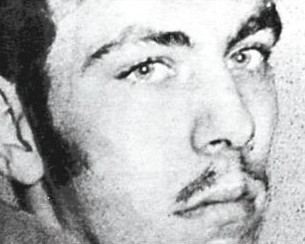
Buddy Earl Justus
Serial killer Donald Henry Gaskins
Serial killer · USA · 1969
Donald Henry Gaskins, also known as Donald “Pee Wee” Gaskins, was a serial kill…
200 victims
Donald Henry Gaskins
Serial killer · USA · 1969
Donald Henry Gaskins, also known as Donald “Pee Wee” Gaskins, was a serial kill…
200 victims
 Carl Eugene Watts
Serial killer · USA · 1974
Carl Eugene Watts (born November 7, 1953; died September 21, 2007), also known…
100 victims
Carl Eugene Watts
Serial killer · USA · 1974
Carl Eugene Watts (born November 7, 1953; died September 21, 2007), also known…
100 victims
 Rodney Alcala
Serial killer · USA · 1977
Rodney James Alcala (born August 23, 1943) was also known as Rodrigo Jacques Al…
100 victims
Rodney Alcala
Serial killer · USA · 1977
Rodney James Alcala (born August 23, 1943) was also known as Rodrigo Jacques Al…
100 victims
 Donald Harvey
Serial killer · USA · 1970
Donald Harvey was known as an American serial killer and a self-professed “Ange…
87 victims
Donald Harvey
Serial killer · USA · 1970
Donald Harvey was known as an American serial killer and a self-professed “Ange…
87 victims
 Donald Leroy Evans
Serial killer · USA · 1975
Donald Leroy Evans (born July 5, 1957) was an American serial killer who murder…
60 victims
Donald Leroy Evans
Serial killer · USA · 1975
Donald Leroy Evans (born July 5, 1957) was an American serial killer who murder…
60 victims
 Michael Swango
Serial killer · USA · 1981
Michael Swango (Joseph Michael Swango) was a physician and American serial kill…
60 victims
Michael Swango
Serial killer · USA · 1981
Michael Swango (Joseph Michael Swango) was a physician and American serial kill…
60 victims
 Danny Joe Bradley
Murderer · USA · 1983
Danny Joe Bradley was tried in Alabama and convicted of capital murder in conne…
1 victim
Danny Joe Bradley
Murderer · USA · 1983
Danny Joe Bradley was tried in Alabama and convicted of capital murder in conne…
1 victim
 Brian Gene Nichols
Murderer · USA · 2005
Brian Gene Nichols was born December 10, 1971. He was known for his escape and…
4 victims
Brian Gene Nichols
Murderer · USA · 2005
Brian Gene Nichols was born December 10, 1971. He was known for his escape and…
4 victims
 Maurice Boucher
Murderer · Canada · 1997
Maurice "Mom" Boucher (born June 21, 1953) was a convicted murderer, a reputed…
2 victims
Maurice Boucher
Murderer · Canada · 1997
Maurice "Mom" Boucher (born June 21, 1953) was a convicted murderer, a reputed…
2 victims
 Gerald Wayne Bivins
Murderer · USA · 1991
Gerald Wayne Bivins · January 16, 1991 — Bivins and two other men committed mul…
1 victim
Gerald Wayne Bivins
Murderer · USA · 1991
Gerald Wayne Bivins · January 16, 1991 — Bivins and two other men committed mul…
1 victim
- Gender
- male
- Country
- USA
- Location
- Georgia/Florida/Virginia, USA
- Date of birth
- December 25, 1952
- Age at first offence
- 26
- Characteristics
- rape, abuse, alcohol, kidnapping, robbery
- Victim profile
- Ida Mae Moses, 21 (8 1/2 months pregnant) / Rosemary Jackson, 32 / Stephanie Hawkins, 21
- Method of murder
- Shooting
- Date(s) of murder
- October 1978
- Years active
- 1978
- Date of arrest
- October 11, 1978
- Status
-
Executed
Executed by electrocution in Virginia on December 13, 1990
Case record: Buddy Earl Justus
Background
Buddy Earl Justus was sentenced to die in the electric chair in Virginia for the rape and slaying of a pregnant nurse in 1978.
He was a native of Niagara Falls, New York. His family moved south and he was placed in a Virginia orphanage. As a young man, he built a record of petty crimes, including a breaking and entering conviction that landed him in the Montgomery County Jail, where he met Charlie Harris, a preacher who attended to the spiritual needs of prisoners.
Justus married, but his wife Alice soon left him. Afterward, he made his way back to Niagara Falls and went to work at the Tire Shoppe. He was described as a conscientious worker during weekdays, changing truck tires without complaint, and as a person employers had not had concerns about on the job.
Justus received brain damage that was worsened by head injuries when he was 20.
A petition urged Governor L. Douglas Wilder to halt the execution and said Justus was a victim of child abuse. Harris talked with Justus on death row and suggested another motivation, saying: "He said when he got word (Alice) was filing for divorce, he just went crazy." Harris added: "He wrote a lot of poems, all of them about Alice."
The offence
On October 3, 1978, Ida Mae Moses was found murdered in her home in Montgomery County, Virginia. She had been shot twice in the face and once in the back of the head, and forensic tests showed that she was 8 1/2 months pregnant at the time of the murder and had also been raped. It was determined that she had been killed by her own gun, a snub-nosed .22 caliber pistol, which was stolen during the incident.
Justus was convicted in Virginia for capital murder during the commission of a rape. He did not deny committing the murder and used his confession of the burglary and murder to bolster the credibility of his denial of the rape.
Justus also received death sentences for murdering Rosemary Jackson, 32, and Stephanie Hawkins, 21.
The Georgia case involved the murder, kidnapping with bodily injury, armed robbery, and rape of Rosemary S. Jackson. The Florida and Georgia proceedings involved separate capital murder convictions and death sentences.
In Georgia, the trial court found that Justus and Dean Goins came to Georgia from Florida and decided to steal a van and rob someone. They pulled into a shopping center and sat there drinking beer until Rosemary S. Jackson parked her van. They abducted the victim at gunpoint and took her to Crack Road, a dirt access-road. The trial court further found that Justus drove the victim's van with the victim inside, and Goins drove the car that they had driven up from Florida. On the way, Justus stopped at a truck stop and made the victim purchase a C. B. unit, and pay for it with a credit card. They proceeded to Crack Road where the appellant raped, stabbed, and shot Mrs. Jackson. The trial court found that Goins was present at the scene but did not participate in the rape or murder.
Forensic evidence established that Rosemary S. Jackson was raped and suffered three stab wounds to her body (one stab wound through the right breast into the right lung through the diaphragm and down into the liver, and two wounds into the back, one to the lower part of the shoulder blade and the other to the top of the right shoulder). The stab wounds occurred prior to death and caused considerable pain. The victim was then shot execution style with a single gunshot wound to the base of the skull just above the hairline.
The New York tag was removed from the car and placed on the van. The car was left near the body, and Justus and Goins left in the van, ultimately being arrested in Virginia. The evidence included that Justus’s fingerprints were located in the abandoned automobile. The manager of the grocery store at the shopping center became suspicious and wrote down the New York license plate number. The appellant was identified as the man coming in with the victim to the Atlanta Gateway Truck Stop where the C. B. radio was purchased.
The Florida case involved Stephanie Michelle Hawkins, 21, taken from outside a sunglasses stand in a shopping plaza. Hawkins was described as having suffered a fate nearly identical to Jackson’s, with her body found in a similar location.
In addition to the offenses in Virginia, Georgia, and Florida, Justus kidnapped Rosemary Jackson and forced her to give what money she had, then raped and murdered her.
Investigation
On October 3, 1978, the murder of Ida Mae Moses occurred in Montgomery County, Virginia. Sheriff Louis E. Barber, who investigated the 1978 rape-slaying of Ida Mae Moses, said he had been haunted by the crime ever since.
Police authorities were looking for Justus based on a description of his car. Authorities staked out the orphanage in Grundy, Virginia, where Justus was raised and where two siblings still lived.
Arrest
On October 11, 1978, petitioner was arrested in Grundy, Virginia, pursuant to an arrest warrant for a Georgia murder.
Justus waived his Miranda rights and confessed that he had burglarized the Moses’ home and had murdered Moses, but he denied raping her.
After his arrest, Justus admitted robbing and murdering Moses, but denied raping her. The jury did not believe him.
Trial
Virginia trial
In January 1979, Justus was indicted for capital murder during the commission of a rape, in violation of Va. Code Secs. 18.2-31(5) and 18.2-32.
At trial, Justus did not deny committing the murder. Instead, he used his confession of the burglary and murder to bolster the credibility of his denial of the rape, conceding the commission of a first degree murder, and attempting to defeat the capital murder charge and its potential death penalty.
The jury recommended the death penalty, and Justus was formally sentenced to die in the electric chair on November 5, 1980.
A Williamsburg, Virginia, jury recommended the death penalty on Justus’s conviction for the rape-murder of a pregnant housewife.
On appeal, the Supreme Court of Virginia reversed the conviction due to an error in the jury-selection process. On remand, Justus was found guilty again and sentenced to death once more, and this time the conviction was upheld on appeal.
Georgia trial
Justus pleaded guilty to the October 7, 1978 murder, kidnapping with bodily injury, armed robbery, and rape of Rosemary S. Jackson. Following a hearing, he was sentenced to life imprisonment for kidnapping with bodily injury, armed robbery, and rape, and to death for the murder. The case was presented for mandatory sentence review and considered companion to Goins v. State.
The Georgia court described the proceedings as including:
- The trial judge appointed an attorney who had practiced law for fourteen to fifteen years and handled over seventeen capital cases to represent the appellant.
- The trial judge apprised Justus of constitutional rights and found that the appellant understood the nature of the proceeding and that the trial judge had no conscientious, moral, or religious objections to a death sentence if warranted by circumstances.
- The trial judge made findings of fact including that Justus was twenty-eight years old, had attended school through the tenth grade, had been tried in a court of law three times prior to the present proceedings, and understood the nature of the proceeding.
During the ten-day interim prior to plea day, the district attorney turned over to the appointed attorney the entire file, the list of witnesses, the statement Justus had made to the Gwinnett County Police, a copy of his FBI rap sheet, a mental evaluation of Justus, and the State Crime Lab Report.
At the plea hearing, Justus was extensively questioned by both the district attorney and the trial judge regarding whether he understood each right and whether he was under the influence of drugs, medicines, or alcohol. The trial judge found that Justus consulted with his attorney four times and his attorney had given him all the time he needed to talk and discuss his situation, and that Justus understood he was pleading guilty without any recommendation by the state and that he pleaded guilty freely and voluntarily without promise of reward or threat of harm. The trial court found that he persisted in his plea of guilty despite the attorney’s determination that Justus had a better chance to avoid the death penalty with a jury than with the court, noting that despite discovery and consultation, there were no material defenses to the charge.
The Georgia record also described psychological evaluations in Virginia and in Georgia affirmatively showing that the appellant was sane at the time he committed the crimes, could actively participate in his defense, and was aware of the nature of the proceedings.
Aggravating circumstances and proportionality review (Georgia)
The Georgia court found that the death sentence was not imposed under the influence of passion, prejudice, or other arbitrary factor.
The trial judge found beyond a reasonable doubt the existence of statutory aggravating circumstances including:
- the murder was committed while engaged in the commission of an additional capital felony, to wit the armed robbery of Rosemary Jackson;
- the murder was committed while engaged in the commission of an additional capital felony, to wit the kidnapping of Rosemary Jackson with bodily injury;
- the murder was committed while engaged in the commission of an additional capital felony, to wit the rape of Rosemary Jackson; and
- the offense of murder was outrageously or wantonly vile, horrible and inhuman in that it involved torture, depravity of mind and an aggravated battery to the victim.
The Georgia court addressed statutory “torture” under prior decisions, stating: "‘Torture’ as the term is used in the statute occurs when the victim is subjected to serious physical abuse prior to death." The court further stated: "Serious sexual abuse may be found to constitute serious physical abuse."
The Georgia court found that Rosemary S. Jackson was not killed instantaneously and was not the victim of a domestic murder, noting she gave the appellant no reason to assault her and was in no manner threatening. It found that the appellant fled and attempted in every manner to hide his crime and concluded that abducted and sexually assaulted prior to death constituted murder that was wantonly vile, horrible, or inhuman, distinguishable from ordinary murders.
The Georgia court reviewed the sentence in light of the lesser sentence imposed on the co-defendant Dean Goins. It concluded that the sentence to death was neither excessive nor disproportionate, citing distinctions between the appellant and Goins including that the appellant was the actual perpetrator of the murder and rape, while the co-defendant remained in the car, and evidence that the appellant was the prime mover and that Goins was coerced into assisting.
The Georgia court stated: "The appellant's sentence to death for murder is not excessive or disproportionate to the penalty imposed in similar cases considering the crime and the defendant."
It listed similar cases in an appendix.
Sentencing
Justus was sentenced to death in Virginia for the rape and slaying of Ida Mae Moses in 1978. He was formally sentenced to die in the electric chair on November 5, 1980. His Virginia conviction was reversed due to jury selection error and later upheld after remand.
In Georgia, after his guilty plea, the court imposed a sentence of life imprisonment for kidnapping with bodily injury, armed robbery, and rape, and a death sentence for the murder of Rosemary S. Jackson.
Justus was also sentenced to death in Florida and Georgia for killing a woman in Florida and another in Georgia at trials in those states. Goins received life imprisonment for his part in the Florida and Georgia murders.
Appeals
Federal habeas proceedings (Fourth Circuit)
Buddy Earl Justus petitioned for a writ of habeas corpus under 28 U.S.C. Sec. 2254 against Edward W. Murray, Director, Virginia Department of Corrections. The case was titled: Buddy Earl Justus, Petitioner-Appellant, v. Edward W. Murray, Director, Virginia Department of Corrections, Respondent-Appellee. No. 89-4005 Federal Circuits, 4th Cir.
- Argued Dec. 5, 1989.
- Decided March 2, 1990.
- Rehearing and Rehearing In Banc Denied March 20, 1990.
The Fourth Circuit described the procedural history and held that, although on different reasoning, it affirmed dismissal of the petition. It stated: "In sum, although on different reasoning, we affirm the dismissal of the petition. AFFIRMED."
The court described:
- On October 11, 1978, Justus was arrested in Grundy, Virginia, pursuant to a Georgia murder warrant and confessed to burglary and murder while denying rape.
- In January 1979, Justus was indicted for capital murder during the commission of a rape.
- Justus’s state habeas proceedings included a hearing on February 13–14, 1985, and denial of the petition in August 1985.
- Subsequent state denials included the Virginia Supreme Court denying a petition for appeal and petition for rehearing, and the U.S. Supreme Court denying certiorari in Justus v. Barss, 479 U.S. 1101.
- Justus filed a federal habeas petition in April 1987, which was dismissed without prejudice due to unexhausted claims by consent.
- He then filed a new habeas petition raising unexhausted claims, which was denied by order dated February 22, 1988 due to procedural default.
- The “instant habeas petition” was filed in district court on May 6, 1988; objections were denied by order dated April 12, 1989.
The Fourth Circuit addressed multiple assignments of error and concluded that procedural defaults precluded review absent cause and prejudice, and that the court found no extraordinary circumstances to excuse default on actual innocence grounds, stating: "We conclude that they have not. The evidence of appellant's guilt is overwhelming. There simply can be no serious question on this record that appellant did, in fact, commit the crime for which he stands convicted."
Outcome
After nine appeals failed, Justus’s execution was scheduled for Dec. 13, 1990.
Governor L. Douglas Wilder refused to grant clemency. Justus’s attorneys had requested that the execution be halted and that the sentence be commuted to life without parole, citing brain damage.
Justus asked for an end to the death penalty and asked the victims’ families to forgive him. His statements included:
- "I want it to be over with, not for me, but for the victims' families," and "I'm ready to go to a better place. I want it to be put to rest."
- "I've asked for forgiveness to a lot of people," and "and I was able to forgive myself."
- "Let me be the last person," and "There is a better way to deal with crimes than taking people's lives." Justus also criticized the death penalty, calling it a "barbaric" form of punishment.
He gave a Roanoke radio station an interview on his last day of life.
Ida Mae Moses’ sister had written Justus telling him she forgave him, according to Justus’s attorney.
Justus ate a last meal that included sirloin steak, french fries, tossed salad, strawberry pie and tea.
Prison officials granted his last request to make the trek alone rather than with prison guards. He was strapped into the electric chair at 11 p.m. Six minutes and two jolts later, Buddy Earl Justus, 37, was dead at the State Penitentiary.
Sheriff Louis E. Barber stated after the execution:
- "Buddy Justus died with a great deal more dignity than he afforded Ida Moses. At least he had his minister present and he wasn't degraded and raped and murdered,"
and Justus had been investigated as the chief investigator in Moses’ murder.
After watching the execution, Sheriff Barber said: "He was afforded a great deal more dignity than Ida Moses," and "At least he had his minister present."
The Rev. Russ Ford told Justus: "Be strong, you'll move on," and Justus gave a slight smile.
Aftermath
Opponents of the death penalty staged vigils in five cities around the state the night of the execution.
The old Virginia State Penitentiary closed the next day, described as the 190-year-old facility in Boydton, and the other inmates and staff had already moved into new facilities.
One account described that the execution followed three death sentences for murdering three women in separate states during 1978, with Justus convicted in Virginia first.
In the federal habeas decision record, the court included a concluding “AFFIRMED” and stated that it affirmed the dismissal of the petition.
In connection with the Georgia decision, the court listed an appendix of similar cases: Kramer v. State, Jarrell v. State, Davis v. State, Gibson v. State, Bowden v. State, Corn v. State, Spraggins v. State, Westbrook v. State, Moore v. State, Johnson v. State, Collins v. State, 246 Ga. 261, Tucker v. State, Gates v. State, Tucker v. State, Brooks v. State, and 246 Ga. 262.
Spotted an error, or have more information about this case?