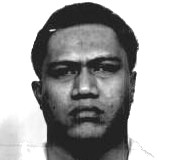
Aua Lauti
Murderer Brian Kevin Rosenfeld
Murderer · USA · 1985
Brian Kevin Rosenfeld Brian Kevin Rosenfeld was sentenced to three concurrent l…
23 victims
Brian Kevin Rosenfeld
Murderer · USA · 1985
Brian Kevin Rosenfeld Brian Kevin Rosenfeld was sentenced to three concurrent l…
23 victims
 Marvin Gray
Murderer · USA · 1975
Marvin Gray was convicted killer who claimed responsibility for 23 slayings and…
23 victims
Marvin Gray
Murderer · USA · 1975
Marvin Gray was convicted killer who claimed responsibility for 23 slayings and…
23 victims
 Yahweh ben Yahweh
Murderer · USA · 1980
Yahweh ben Yahweh was born and legally named Hulon Mitchell Jr. (October 27, 19…
23 victims
Yahweh ben Yahweh
Murderer · USA · 1980
Yahweh ben Yahweh was born and legally named Hulon Mitchell Jr. (October 27, 19…
23 victims
 Russell Ellwood
Murderer · USA · 1991
Russell Ellwood was a former taxi driver. Authorities suspected him of killing…
20 victims
Russell Ellwood
Murderer · USA · 1991
Russell Ellwood was a former taxi driver. Authorities suspected him of killing…
20 victims
 Thomas Harrison Provenzano
Murderer · USA · 1984
21 July 2000 — Thomas Harrison Provenzano was executed by lethal injection in F…
1 victim
Thomas Harrison Provenzano
Murderer · USA · 1984
21 July 2000 — Thomas Harrison Provenzano was executed by lethal injection in F…
1 victim
 William Lembcke
Mass murderer · USA · 2000
William Lembcke killed his parents and his sister and brother at their home, th…
4 victims
William Lembcke
Mass murderer · USA · 2000
William Lembcke killed his parents and his sister and brother at their home, th…
4 victims
 Hubert Glenn Sexton
Murderer · USA · 2000
Hubert Glenn Sexton was convicted in Tennessee for first degree murder of Stanl…
2 victims
Hubert Glenn Sexton
Murderer · USA · 2000
Hubert Glenn Sexton was convicted in Tennessee for first degree murder of Stanl…
2 victims
 Patrick Henry Sherrill
Mass murderer · USA · 1986
Patrick Henry Sherrill Patrick Henry Sherrill committed suicide by shooting him…
14 victims
Patrick Henry Sherrill
Mass murderer · USA · 1986
Patrick Henry Sherrill Patrick Henry Sherrill committed suicide by shooting him…
14 victims
- Gender
- male
- Country
- USA
- Location
- Harris County, Texas, USA
- Date of birth
- J une 18, 1954
- Age at first offence
- 31
- Characteristics
- rape, kidnapping
- Victim profile
- Tara Lauti, 9 (his cousin)
- Method of murder
- Strangulation
- Date(s) of murder
- December 18, 1985
- Years active
- 1985
- Date of arrest
- —
- Status
-
Executed
Executed by lethal injection in Texas on November 4, 1997
Case identification
Offender: Aua Lauti (also written as Aua LAUTI) Appellate matter: Aua LAUTI, Petitioner-Appellee, v. Gary JOHNSON, Director, Texas Department of Criminal Justice, Institutional Division, Respondent-Appellant. Docket number: No. 96-20003 Court: United States Court of Appeals, Fifth Circuit Panel: JOLLY, JONES and STEWART, Circuit Judges Authoring judge: EDITH H. JONES, Circuit Judge
STATUS
Aua Lauti was executed by lethal injection in Texas on November 4, 1997.
Timeline
- December 18, 1985 — Lauti abducted his 9-year-old cousin, Tara Lauti, drove her to a field off East Mount Houston Road in northeast Harris County, sexually assaulted her, and beat her to death.
- September 1986 — Lauti was convicted of the capital offense of murder during the course of an aggravated sexual assault and kidnapping.
- 1975 — Lauti was convicted in Hawaii of first degree rape in which he had also beaten his victim while high from sniffing paint.
- 1981 — Lauti threatened motorists and a Honolulu Police Department officer with a machete while apparently “under the influence of paint.”
- December 13, 1996 — The Fifth Circuit decided the appeal.
Background
In September 1986, Aua Lauti was convicted of the capital offense of murder during the course of an aggravated sexual assault and kidnapping.
The State’s evidence described an incident in which Lauti went to the home of his uncle, who lived with his wife and their four young children, and Lauti’s cousins. One evening in the prior December, it was obvious that Lauti had been drinking and was intoxicated when he arrived. After visiting with his uncle, Lauti told his uncle that he was going home. Instead of going home, Lauti apparently indulged in more drink.
Before the end of the evening, Lauti had consumed at a minimum two twelve-packs of beer and four quarts of malt liquor. Five or ten minutes after leaving his uncle’s home the second time, Lauti returned unexpectedly and either went to sleep or pretended to sleep in one of the bedrooms.
After finding Lauti apparently asleep, the uncle took his two oldest daughters and drove approximately four miles to Lauti’s parents’ house, where Lauti’s aunt and brother-in-law lived. The family retrieved Lauti from his uncle’s house.
On returning, the relatives discovered that Lauti was gone; also missing was the uncle’s nine year-old daughter, Tara Lauti, Lauti’s cousin.
Lauti’s parents and brother began searching and found Lauti several miles away. After being quizzed, Lauti directed his parents and brother to Tara, whom they found at a location described by Lauti. Tara was covered with mud, her face was bruised and bleeding, and she was naked from the waist down.
They transported Tara to Lauti’s uncle’s house where it was determined that Tara was dead. Tara died from three injuries, any one of which would have been sufficient to kill her: a skull fracture, asphyxiation due to strangulation, and a crushed chest.
The offence
On December 18, 1985, Lauti abducted 9-year-old cousin Tara Lauti and drove her to a field off East Mount Houston Road in northeast Harris County. Tara was sexually assaulted and beaten to death.
Lauti gave a written statement to the authorities after being arrested and informed of his legal rights. The statement was presented to the jury and described the murder in detail. Lauti admitted abducting Tara from her home after knocking her unconscious by hitting her in the head with his fist. He then took her into his car where she regained consciousness while he was driving, and he again knocked her unconscious with an empty quart malt liquor bottle.
After reaching a location that suited him, he carried her into a field where he hit her in the chest with his fist, removed her clothes from the waist down, and digitally penetrated her vagina. He then attempted unsuccessfully to rape her. At that point, he hit her in the chest again with his fist, choked her with his hands for about five minutes, and left her in the field.
Investigation
After being arrested and informed of his legal rights, Lauti gave a written statement to the authorities. The statement described the murder in detail and was presented to the jury.
Arrest
Lauti was arrested and informed of his legal rights before giving the written statement to authorities.
Trial
Conviction
The jury convicted Lauti of capital murder. The jury affirmatively answered the two special issues, and the trial court sentenced Lauti to death.
Sentencing phase special issues
The special issues presented to the jury, pursuant to TEX.CODE CRIM.PROC.ANN. art. 37.071(b) (Vernon 1981), were:
- “Was the conduct of the defendant, Aua Lauti, that caused the death of the deceased committed deliberately and with the reasonable expectation that the death of the deceased or another would result?”
- “Is there a probability that the defendant, Aua Lauti, would commit criminal acts of violence that would constitute a continuing threat to society?” (R.Tr. IV at 1074-75.)
Instruction on temporary insanity caused by intoxication
During sentencing, the trial court charged the jury using TEX.PENAL CODE ANN. § 8.04(b). The court stated:
“Evidence of temporary insanity caused by intoxication may be introduced by the defendant in mitigation of the penalty attached to the offense for which he is being tried. Intoxication means disturbance of mental or physical capacity resulting from the introduction of any substance into the body. Temporary insanity caused by intoxication means that the defendant's mental capacity was so disturbed from the introduction of a substance into his body that the defendant did not know that his conduct was wrong or was incapable of conforming his conduct to the requirements of the law he allegedly violated.”
During the appellate discussion, the Fifth Circuit quoted an instruction that was virtually identical:
“Evidence of temporary insanity caused by intoxication may be introduced by the defendant in mitigation of the penalty attached to the offense for which he is being tried. Intoxication means disturbance of mental or physical capacity resulting from the introduction of any substance into the body. Temporary insanity caused by intoxication means that the defendant's mental capacity was so disturbed from the introduction of a substance into his body that the defendant either did not know that his conduct was wrong or was incapable of conforming his conduct to the requirements of the law he allegedly violated.” (R.Tr. IV at 1070.)
Immediately before reading the challenged instruction, the trial court charged the jury to consider all evidence presented to it:
“You are further instructed that in determining each of these Special Issues, you may take into consideration all of the evidence submitted to you in the full trial of the case, that is, all of the evidence submitted to you in the first part of this case wherein you were called upon to determine the guilt or innocence of the defendant, and all of the evidence, if any, admitted before you in the second part of the trial wherein you are called upon to determine the answers to Special Issues hereby submitted to you.” (R.Tr. IV at 1070 (emphasis added).)
Mitigation evidence and prior history presented at sentencing
At the sentencing phase, the jury heard testimony that in 1975 Lauti was convicted in Hawaii of first degree rape in which he had also beaten his victim while high from sniffing paint.
The jury also heard that in 1981 Lauti threatened motorists and a Honolulu Police Department officer with a machete while apparently “under the influence of paint.”
Closing arguments on intoxication mitigation
Both the State and defense counsel presented brief closing arguments.
Lauti’s counsel told the jury:
“At this particular point in the trial, I speak to you, as the Judge read to you as he brought you the charge, where we are dealing with the issue of intoxication; not as a defense, but as a mitigation. Now intoxication can be taken into consideration by the jury to decide.” (R. S.F. at 876 (emphasis added).)
The same closing argument continued:
“We are talking about this man right here and what alcohol did to him, what that alcohol, that amount--the State says that is not a defense. But one takes it into consideration, whether it was a deliberate act in contravention of what society believes is right or wrong.... . . . . . Because of the intoxication he couldn't conform to our society--to our society.” (R. S.F. at 879 (emphasis added).)
Counsel and prosecutor arguments in the appellate discussion
In the sentencing-phase discussion on appeal, it was stated that the defense counsel’s arguments would have led the jury to believe it could consider any evidence of Lauti’s intoxication—not just intoxication rising to the level of temporary insanity—in mitigation of a death sentence.
The prosecutor did not challenge the relevance of Lauti’s intoxication on the Texas punishment issues of deliberateness and future dangerousness, and the prosecutor contended that the evidence of intoxication supported affirmative answers to the questions.
It was also stated that neither side treated the TEX. PENAL CODE ANN. § 8.04(b) instruction as an exclusive vehicle for assessing the mitigating impact of intoxication evidence.
Appeals
After direct appeal and a state habeas action, Lauti filed a petition for federal habeas relief.
The district court granted the writ. The district court ruled that the § 8.04(b) instruction, as given, prevented the jury from considering intoxication other than intoxication rising to the level of temporary insanity in mitigation of a death sentence, and that Lauti’s constitutional rights were violated.
The district court also ruled that because Lauti’s trial attorney failed to object to that instruction, Lauti received ineffective assistance of counsel in violation of the sixth amendment.
The State appealed.
Appellate issue
The principal issue on appeal was whether a Texas jury instruction concerning intoxication, Tex. Penal Code § 8.04(b), unconstitutionally prevented the jury from considering benumbed state as mitigating evidence even if it did not rise to the level of temporary insanity.
The Fifth Circuit discussed Drinkard v. Johnson, 97 F.3d 751 (5th Cir. 1996), stating that the intoxication instruction was not unconstitutional. The Fifth Circuit concluded that the district court decision holding otherwise had to be reversed.
Appellate holding on instruction
The Fifth Circuit rejected the district court’s analysis and upheld the intoxication instruction, stating that, in analyzing challenged instructions in capital sentencing, the proper standard was whether there was a reasonable likelihood the jury applied the challenged instruction in a way that prevented consideration of constitutionally relevant evidence.
The Fifth Circuit stated that the challenged instruction did not place consideration of non-insane intoxication beyond the effective reach of the jury. It also stated that the trial court’s general instruction told the jury to consider all evidence submitted to it in determining the special issues, strongly supporting that the jury understood the instructions as a whole as not precluding consideration of non-insane intoxication.
The Fifth Circuit also treated the arguments of counsel during sentencing as supporting the conclusion that the jury was informed and encouraged to consider evidence of Lauti’s intoxication in mitigation of a death sentence.
Appellate holding on ineffective assistance of counsel claim
The Fifth Circuit stated that because the jury instruction was approved, the ineffectiveness claim necessarily fell.
Outcome
The Fifth Circuit reversed the decision of the district court granting habeas relief and vacated the district court’s order staying execution.
The Fifth Circuit’s conclusion stated:
“For the foregoing reasons, we REVERSE the decision of the district court granting habeas relief and VACATE the district court's order staying execution.”
It was also stated that:
- Writ relief was denied to petitioner Lauti.
Aftermath
After the Fifth Circuit reversed the district court’s habeas grant and vacated the order staying execution, Lauti was executed by lethal injection in Texas on November 4, 1997.
Other details
Offender number: Aua Lauti #843 Age: 43 (31) Education level: 9th grade Last statement:
“I am so glad I found God and I am so happy for it. I love my family and I want them to know that. That is about all I have to say.”
Spotted an error, or have more information about this case?