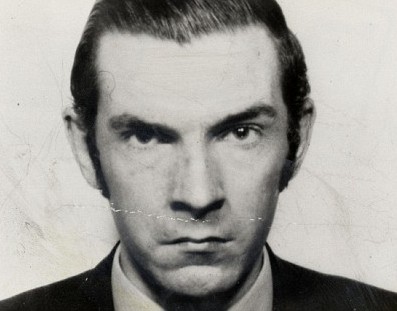
Graham Young
Homicide - Murderer John Donald Merrett
Homicide - Murderer · United Kingdom · 1926
John Donald Merrett (also known as Ronald Chesney) was born in New Zealand in 1…
3 victims
John Donald Merrett
Homicide - Murderer · United Kingdom · 1926
John Donald Merrett (also known as Ronald Chesney) was born in New Zealand in 1…
3 victims
 Kenneth Noye
Homicide - Murderer · United Kingdom · 1983
Kenneth Noye was a British criminal. Noye was involved in laundering the procee…
2 victims
Kenneth Noye
Homicide - Murderer · United Kingdom · 1983
Kenneth Noye was a British criminal. Noye was involved in laundering the procee…
2 victims
 Carl Brandt
Homicide - Murderer · USA · 1971
Carl “Charlie” Brandt · Jan. 3, 1971 — Carl Brandt killed his pregnant mother a…
6 victims
Carl Brandt
Homicide - Murderer · USA · 1971
Carl “Charlie” Brandt · Jan. 3, 1971 — Carl Brandt killed his pregnant mother a…
6 victims
 Dwaine Little
Homicide - Murderer · USA · 1964
Name: Dwaine Little (Dwain Lee Little) · Birth year: 1948 · Little raped and ki…
5 victims
Dwaine Little
Homicide - Murderer · USA · 1964
Name: Dwaine Little (Dwain Lee Little) · Birth year: 1948 · Little raped and ki…
5 victims
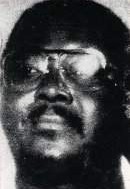 James Edward Pough
Mass murderer · USA · 1971
James Edward Pough (1948 – 18 June 1990) was an American mass murderer. On 18 J…
12 victims
James Edward Pough
Mass murderer · USA · 1971
James Edward Pough (1948 – 18 June 1990) was an American mass murderer. On 18 J…
12 victims
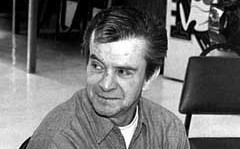 Carroll Edward Cole
Serial killer · USA · 1948
Carroll Edward Cole, also known as “Eddie,” was born in Sioux City, Iowa on May…
15 victims
Carroll Edward Cole
Serial killer · USA · 1948
Carroll Edward Cole, also known as “Eddie,” was born in Sioux City, Iowa on May…
15 victims
 Stanley Neace
Mass murderer · USA · 2011
Stanley Neace, aged 47, killed his wife and five others in Breathitt County, Ke…
5 victims
Stanley Neace
Mass murderer · USA · 2011
Stanley Neace, aged 47, killed his wife and five others in Breathitt County, Ke…
5 victims
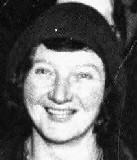 Jeannie Donald
Murderer · United Kingdom · 1934
Jeannie Donald was tried in July 1934 for the murder of Helen Priestly. Helen P…
1 victim
Jeannie Donald
Murderer · United Kingdom · 1934
Jeannie Donald was tried in July 1934 for the murder of Helen Priestly. Helen P…
1 victim
 Floyd Allen Medlock
Murderer · USA · 1990
Floyd Allen Medlock was executed by lethal injection in Oklahoma on January 16,…
1 victim
Floyd Allen Medlock
Murderer · USA · 1990
Floyd Allen Medlock was executed by lethal injection in Oklahoma on January 16,…
1 victim
 Domingo Salazar
Mass murderer · Philippines · 1956
Domingo Salazar was resentenced to reclusion perpetua on June 30, 1959, after h…
16 victims
Domingo Salazar
Mass murderer · Philippines · 1956
Domingo Salazar was resentenced to reclusion perpetua on June 30, 1959, after h…
16 victims
- Gender
- male
- Country
- United Kingdom
- Location
- London/Bovington, United Kingdom
- Date of birth
- September 7, 1947
- Age at first offence
- 15
- Characteristics
- juvenile (15), poisoner
- Victim profile
- Molly Young (his stepmother) / Bob Egle and Fred Biggs (work colleagues)
- Method of murder
- Poisoning (thallium/antimony)
- Date(s) of murder
- 1962 / 1971
- Years active
- 1962–1971
- Date of arrest
- —
- Status
-
Died in custody
Sentenced to life in prison in 1972; died in prison on August 1, 1990
Case overview
Graham Young was convicted as a “Teacup Poisoner” for poisoning multiple people with thallium and was sentenced to life imprisonment in 1972. He died in prison on 1 August 1990.
Background
Graham Frederick Young was born in Neasden, North London, on 7 September 1947, to Fred and Bessie Young.
His mother developed pleurisy during pregnancy and died of tuberculosis three months after his birth. Fred Young was devastated and put the infant into the care of his aunt Winnie, while his elder sister, Winifred, was taken in by her grandparents.
Young spent the first two years of his life with his aunt and her husband, Jack, and became very close to them. When his father remarried in 1950, the family reunited in St. Albans with his new wife, Molly. Young showed visible signs of distress at being separated from his aunt.
Young became solitary, with little interest in socialising with others his own age. When he was old enough to read, he favoured sensationalist non-fiction accounts of murders, and Dr. Crippen was a particular favourite.
By the time he reached his teens, Young developed an unhealthy fascination with Adolf Hitler and took to wearing swastikas, describing Hitler as a “misunderstood” figure. He also read widely on the occult, claiming knowledge of Wiccans and local covens and trying to involve local children in occult ceremonies that involved sacrificing a cat on one occasion. The disappearance of local cats around the same time was also described as possibly linked to these ceremonies.
Academically, his only interests were chemistry, forensic science and toxicology. His father encouraged him by buying Young a chemistry set, which absorbed his attention for hours at a time.
By the age of 13, Young’s knowledge of toxicology enabled him to convince local chemists that he was 17. He procured quantities of poisons including antimony, digitalis and arsenic for “study” purposes, as well as quantities of thallium.
The offence
Poisoning of Christopher Williams
Young’s first victim was Christopher Williams, a fellow science pupil. Williams suffered an extended period of vomiting, painful cramps and headaches after Young administered a cocktail of poisons. Williams was lucky to survive.
Poisoning within the Young family (early 1961 to 21 April 1962)
In early 1961, the family began showing intermittent signs of poisoning. Young’s father initially suspected accidental harm from Young’s chemistry set, but Young denied the accusation. The possibility of deliberate poisoning was described as never being considered at that time.
In November 1961, Young’s elder sister Winifred was found by doctors to have been poisoned by Belladonna. Young’s father again suspected him but took no action.
Molly Young, Young’s stepmother, became increasingly ill. On 21 April 1962, Molly was found by her husband writhing in agony in the back garden of their home, with Young looking on in fascination. She was rushed to hospital and died later that night.
Her cause of death was determined as a prolapse of a spinal bone, and she was cremated, with no further action taken at the time. It was later discovered that she had developed a tolerance to the antimony Young had been slowly poisoning her with, and that he switched to thallium the night before her death to speed up the process.
Reports of further nausea and vomiting attacks at her funeral were also described.
Poisoning of Fred Young
After Molly’s death, Fred Young’s vomiting and cramping became more frequent and increasingly severe. He was admitted to hospital and diagnosed with antimony poisoning.
Investigation
Young’s school chemistry teacher contacted the police after discovering poisons and substantial material about poisoners in Young’s school desk. Young was sent to a police psychiatrist, and his knowledge of poisons became apparent.
Forensic enquiries later revealed the thallium poisoning, described as the first recorded case of deliberate poisoning by this heavy metal ever recorded.
Investigators also found that Young’s conviction was soon unearthed, as were his collection of poisons and meticulous diaries recording dosages administered to individuals and their reactions over time.
Arrest
Young was arrested on 23 May 1962 after being detained under psychiatric assessment. He admitted the poisoning of his father, sister and school friend, Williams, but no murder charges were brought against him for the murder of his stepmother because evidence had been destroyed at the time of her cremation.
After release, further poisonings occurred following his employment.
On 21 November 1971, Young was arrested in Sheerness, Kent, while visiting his father. A quantity of thallium was found on his person. Under interrogation, he admitted verbally to the poisonings but refused to sign a written admission of guilt.
Police also discovered thallium and other materials in his possessions. A diary was found containing entries about the doses administered, the effects, and decisions about whether he intended each person to live or die.
Trial
Commencement and charges
Young’s trial commenced on 19 June 1972 at St Albans Crown Court.
He was charged with two counts of murder, two counts of attempted murder, and two counts of administering poison.
Plea and conduct
Young pleaded not guilty and was described as confident that he would be acquitted. He believed his previous conviction could not be entered into evidence and that it would be impossible to identify him as the only person with the means to poison Egle and Biggs. He engaged with media attention during his trial and was described as doing his best to appear sinister, though he was reportedly less pleased with the sobriquet “The Teacup Poisoner,” feeling it belittled his skill and knowledge.
He expressed a preference for being called “World Poisoner.”
He had also advanced claims about the diary, arguing it was a fantasy and that his confession to police was not a written admission of guilt.
Verdict and sentencing
Young was found guilty on all charges on 29 June 1972, receiving four life sentences.
Sentencing
Young received four life sentences on 29 June 1972. A later account also described that he received four counts of life imprisonment alongside two five-year sentences.
The sentencing was followed by a courtroom rider calling for an urgent review of UK laws covering the sale of poisons.
Appeals
No appeal information was included in the provided material.
Outcome
Young was convicted of murder, attempted murder, and administering poison, and was sentenced to life in prison in 1972.
Prison life and related deaths
While incarcerated in Broadmoor maximum-security hospital, a death of inmate John Berridge by cyanide poisoning occurred within weeks. Young claimed he extracted cyanide from laurel bush leaves, but his confession was not taken seriously and Berridge’s death was recorded as suicide.
On other occasions, staff and inmates’ drinks were found to have been tampered with, including the introduction of abrasive sodium compound (“sugar soap”) into a tea urn. The material described that it could have caused mass poisoning but was discovered.
In June 1970, Young’s doctors recommended his release, describing him as “cured.” After release from Broadmoor on 4 February 1971 at age 23, Young worked and continued to obtain poisons.
Young was incarcerated at Parkhurst prison on the Isle of Wight after his 1972 conviction.
He befriended Ian Brady at Parkhurst. Brady described Young as genuinely asexual, excited only by power, clinical experimentation, observation and death. The material described that they played chess and bonded over their fascination with Nazi Germany, and that Young regularly sported a Hitler moustache.
Release-related comments and prison recommendations
Young celebrated the recommendation for release by informing a psychiatric nurse that he intended to kill one person for every year he had been in Broadmoor. The comment was recorded on his file but reportedly did not influence the decision to release him.
In June 1970, Dr. Edgar Udwin, the prison psychiatrist, wrote to the home secretary to recommend his release, announcing that Young “is no longer obsessed with poisons, violence and mischief.”
When asked whether he felt remorse, he replied:
“What I feel is the emptiness of my soul.”
Aftermath
Reforms and inquiries
After the jury was apprised of Young’s previous conviction and his release as a “cured” mental patient only months before the crimes took place, the jury recommended an urgent review of the law regarding the public sale of poisons.
The Home Secretary announced an immediate review of the control, treatment, assessment and release of mentally unstable prisoners, despite Young being regarded as legally sane during his trial. The Aarvold Report, published in January 1973, led to reform in how such prisoners were monitored upon release and resulted in the creation of the Advisory Board for Restricted Patients.
Death in prison
Young died in his cell at Parkhurst on 1 August 1990 at age 42. The official cause of death was heart failure, and another account listed the cause of death as myocardial infarction.
No further confirmed details about the cause of death beyond these official listings were provided in the material.
Biographical and cultural references
The material described that a 16-year-old Japanese schoolgirl was arrested for poisoning her mother with thallium in November 2005 after being fascinated by Young and seeing a 1995 film.
A black comedy about Young’s life, “The Young Poisoner’s Handbook,” was released in 1995. A book published in 2013 about the murders was also described.
People
- Graham Frederick Young — defendant; serial killer; referred to as “The Teacup Poisoner”
- Fred Young — Young’s father; later diagnosed with antimony poisoning
- Bessie Young — Young’s mother; died of tuberculosis three months after his birth
- Winnie (Aunt Winnie) — Young’s aunt
- Jack — Winnie’s husband
- Winifred Young — Young’s sister
- Molly Young — Young’s stepmother; died on 21 April 1962
- Christopher Williams — school friend and victim; suffered vomiting, cramps and headaches after being poisoned
- John Berridge — Broadmoor inmate; died of cyanide poisoning (recorded as suicide)
- Bob Egle — workplace manager; died on 7 July 1971, with cause of death recorded as pneumonia
- Fred Biggs — workplace employee; died on 19 November 1971 after hospitalisation for symptoms described as severe
- Trevor Sparkes — hostel resident; suffered cramps and sickness associated with proximity to Young
- Ian Brady — fellow prisoner at Parkhurst; described as Moors murderer
- Dr. Edgar Udwin — prison psychiatrist who wrote to recommend release
- Geoffrey Hughes — Young’s school chemistry teacher who contacted police
- Reginald Maudling — Home Secretary who announced immediate reviews after the verdict
- Peter Goodman — defence lawyer mentioned in connection with courtroom remarks
- Susan Nowak — reporter mentioned as attending court
Places
- Neasden, North London — Young’s birthplace
- St. Albans — where Young’s family reunited in 1950
- Broadmoor maximum-security hospital — where Young was committed
- St Albans Crown Court — where Young was tried
- Parkhurst prison, Isle of Wight — where Young was incarcerated after conviction and where he died
- Sheerness, Kent — where Young was arrested on 21 November 1971
- Hemel Hempstead — where Young visited and where his sister moved after marriage (as described)
- Bovingdon, Hertfordshire — where Young worked at John Hadland Laboratories
- Slough — described location for early work after release
Timeline
- 7 September 1947 — Graham Frederick Young was born in Neasden, North London.
- 1950 — Young’s father remarried and reunited the family in St.
- Early 1961 — The Young family began showing intermittent signs of poisoning.
- November 1961 — Winifred Young was found by doctors to have been poisoned by Belladonna.
- 21 April 1962 — Molly Young was found writhing in agony in the back garden of their home and died later that night.
- 23 May 1962 — Young was arrested after police psychiatrist assessment; he admitted poisoning his father, sister and school friend, Williams.
- June 1970 — Doctors recommended Young be released as he had been “cured.”
- 4 February 1971 — Young was released from Broadmoor, aged 23.
- 7 July 1971 — Bob Egle died, with death recorded as pneumonia.
- 19 November 1971 — Fred Biggs died after suffering in agony following hospitalisation.
- 21 November 1971 — Young was arrested in Sheerness, Kent; thallium was found on his person.
- 19 June 1972 — Young’s trial commenced at St Albans Crown Court.
- 29 June 1972 — Young was found guilty on all charges and received four life sentences.
- January 1973 — The Aarvold Report was published.
- 1 August 1990 — Young died in his cell at Parkhurst prison.
Spotted an error, or have more information about this case?