Margaret Dickson
Murderer Sarah Malcolm
Murderer · United Kingdom · 1733
Sarah Malcolm was a powerfully built 22-year-old Irish laundress employed in th…
3 victims
Sarah Malcolm
Murderer · United Kingdom · 1733
Sarah Malcolm was a powerfully built 22-year-old Irish laundress employed in th…
3 victims
 Catherine Hayes
Murderer · United Kingdom · 1726
Catherine Hayes (also spelled Catharine Hayes) was an English murderess. Cather…
1 victim
Catherine Hayes
Murderer · United Kingdom · 1726
Catherine Hayes (also spelled Catharine Hayes) was an English murderess. Cather…
1 victim
 Margaret Waters
Murderer · United Kingdom · 1866
Margaret Waters was an English murderess who was hanged by executioner William…
19 victims
Margaret Waters
Murderer · United Kingdom · 1866
Margaret Waters was an English murderess who was hanged by executioner William…
19 victims
 Catherine Wilson
Murderer · United Kingdom · 1854
Catherine Wilson was a British nurse who poisoned victims after befriending the…
7 victims
Catherine Wilson
Murderer · United Kingdom · 1854
Catherine Wilson was a British nurse who poisoned victims after befriending the…
7 victims
 Florence Ransom
Murderer · United Kingdom · 1940
Florence Ransom was a middle-aged woman who was described as physically beautif…
3 victims
Florence Ransom
Murderer · United Kingdom · 1940
Florence Ransom was a middle-aged woman who was described as physically beautif…
3 victims
 James Efflo Tyrer
Murderer · USA · 1980
James Efflo Tyrer (February 25, 1939 – September 15, 1980) was an American foot…
1 victim
James Efflo Tyrer
Murderer · USA · 1980
James Efflo Tyrer (February 25, 1939 – September 15, 1980) was an American foot…
1 victim
 John Bruce Vining
Murderer · USA · 1987
John Bruce Vining John Vining was convicted and sentenced to death for the murd…
1 victim
John Bruce Vining
Murderer · USA · 1987
John Bruce Vining John Vining was convicted and sentenced to death for the murd…
1 victim
 James Emery Paster
Murderer · USA · 1980
James Emery Paster (#752) was convicted of capital murder and sentenced to deat…
3 victims
James Emery Paster
Murderer · USA · 1980
James Emery Paster (#752) was convicted of capital murder and sentenced to deat…
3 victims
 Saber & Mahmoud Abu el-Ulla
Mass murderers · Egypt · 1993
This case concerns Saber Abu el-Ulla and his brother, Mahmoud Abu el-Ulla, who…
13 victims
Saber & Mahmoud Abu el-Ulla
Mass murderers · Egypt · 1993
This case concerns Saber Abu el-Ulla and his brother, Mahmoud Abu el-Ulla, who…
13 victims
 Ira Einhorn
Murderer · USA · 1977
Name: Ira Samuel Einhorn · Date of birth: May 15, 1940 · September 9, 1977 — Ho…
1 victim
Ira Einhorn
Murderer · USA · 1977
Name: Ira Samuel Einhorn · Date of birth: May 15, 1940 · September 9, 1977 — Ho…
1 victim
- Gender
- female
- Country
- United Kingdom
- Location
- Edinburgh, Scotland, United Kingdom
- Date of birth
- 1702
- Age at first offence
- 22
- Characteristics
- infanticide, torture
- Victim profile
- Her newborn baby
- Method of murder
- ????
- Date(s) of murder
- 1724
- Years active
- 1724
- Date of arrest
- —
- Status
-
Executed
Executed by hanging at Edinburgh on September 2, 1724.
Case summary
Margaret Dickson was executed by hanging at Edinburgh on September 2, 1724.
She was tried at Edinburgh for infanticide, namely that she murdered her newborn baby. She had been a domestic worker and, in her account, she had become pregnant by one of the sons of the household. To avoid losing her job, she concealed the fact that she was pregnant and gave birth in secret.
She stated that the child was born dead and that she disposed of the body on the banks of the local river Tweed. The small body was discovered later the same day, and investigations led back to Margaret Dickson. When questioned, she admitted that the baby had been hers but maintained that it had already been dead and that her only crime was attempting to conceal the body.
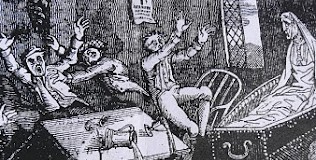
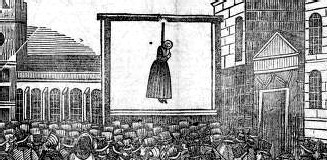
A crowd gathered to witness the hanging. Margaret Dickson was hanged and her body was left suspended for the customary 30 minutes. Her body was cut down and taken away in a coffin on a cart to be buried several miles away.
At one stage, the driver of the cart had stopped for a break and thought he heard noises coming from the coffin. When the coffin was checked, Margaret Dickson was found to be alive. She received a full pardon, and she went on to live for many years after, with the later narrative giving the figure of “another 25 years.” In the extended narrative, she was known as “Half-Hangit” Margaret Dickson.
Timeline
- 2 September 1724 — Margaret Dickson was hanged at Edinburgh; her body was suspended for about the customary 30 minutes; she was later found to have revived in the coffin and was pardoned.
The offence
Margaret Dickson’s crime involved the death of her newborn baby and the concealment of the pregnancy and birth. She was convicted of infanticide/murder of her “bastard child” in the account describing her as having been executed at Edinburgh for the “MURDER of her Bastard Child.”
Background and personal circumstances
Margaret Dickson worked as a domestic. She was described as having married a fisherman who was impressed on board one of the ships of war, leaving her while he was abroad.
In the narrative describing her life, she became acquainted with a man in the same neighbourhood who seduced her, resulting in her becoming “with child.” Her pregnancy led to a public rebuke from the minister, described as occurring on three different Sundays, because in the local practice women guilty of fornication were obliged to sit in a conspicuous place in church and receive a public rebuke.
She denied being pregnant despite her neighbours accusing her of it, and as the time of delivery drew near she attempted to conceal it. In the narrative, during the course of evidence it appeared that she had been apparently pregnant though she continued to deny it, and that a child was found dead near the place where she lived with signs “about her all the appearances of a delivery.”
Investigation
Investigators traced the dead infant to Margaret Dickson on the same day the body was discovered.
There was medical evidence about whether the child had breathed. In one account, the surgeon examined the body by putting the lungs into water, and some physicians said this experiment was not always dependable. In the same account, the surgeon deposed that when the lungs of the child were put into water they “swimmed,” which led to the opinion that the child had breathed, because unless a child has breathed so that air could be drawn into the lungs, those parts of the body would not swim.
Arrest and detention
Margaret Dickson was apprehended on suspicion and committed to Edinburgh Gaol. She was described as having been extremely penitent while in confinement.
Trial
At Edinburgh, the jury found her guilty and she received sentence of death by hanging.
During the evidence produced against Margaret Dickson, depositions of several witnesses stated that she had been apparently pregnant although she continued to deny it. The evidence also included that a child was found dead near the place where she lived and that there were appearances of delivery about her.
Margaret Dickson acknowledged that she had in many instances neglected her duty and that she had been guilty of fornication, but to the last she denied murdering the child and denied that she had the least intention of doing so. She gave reasons for concealing the birth: fear of being made a public example in the church and a “laughing-stock” to her neighbours. She said she was suddenly taken in labour sooner than expected, and that her agonies prevented her from getting assistance and left her in a state of insensibility, so that what became of her child she could not say.
Sentencing
Margaret Dickson received sentence of death by hanging.
Execution and immediate aftermath
Margaret Dickson was brought to the gallows and behaved in the most penitent manner. She was turned off and hung “the usual time.”
After she was cut down, her body was given to her friends, who put her into a coffin to carry it to Musselburgh for interment. The cart carrying the coffin stopped at a village called Pepper Mill about two miles from Edinburgh so the men could get refreshments, leaving the cart with the body near the door.
While the men were drinking, one man thought he saw the lid of the coffin move. He uncovered it and saw Margaret Dickson move and arise upright in her coffin. Others took to their heels with fear. A gardener went to the coffin, opened a vein, and within an hour Margaret Dickson was so well recovered as to be able to go to bed.
Next morning she walked home to Musselburgh. The narrative also describes that officials decided the sentence had already been carried out and that she was freed, with the result that she became a local celebrity. The later narrative states that she was given a full pardon and lived another 25 years.
Other details
- A separate narrative describes her as being hanged in the Grassmarket on September 2, 1724, and describes a death being pronounced by an attending doctor before she was revived in the coffin.
- In the extended narrative, her husband “forgave her” and “married her for second time,” and they had a son named James Spence, described as arriving ten months after her trial.
- The narrative describes a pub in the Grassmarket being named “Maggie Dickson’s” after her memory.
Spotted an error, or have more information about this case?