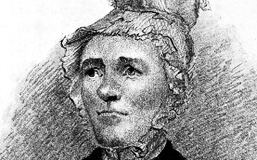
Elizabeth Ross
Murderer Mary Ann Burdock
Murderer · United Kingdom · 1833
Mary Ann Burdock was an attractive Bristol landlady who ran a boarding house. S…
1 victim
Mary Ann Burdock
Murderer · United Kingdom · 1833
Mary Ann Burdock was an attractive Bristol landlady who ran a boarding house. S…
1 victim
 Margaret Waters
Murderer · United Kingdom · 1866
Margaret Waters was an English murderess who was hanged by executioner William…
19 victims
Margaret Waters
Murderer · United Kingdom · 1866
Margaret Waters was an English murderess who was hanged by executioner William…
19 victims
 Catherine Wilson
Murderer · United Kingdom · 1854
Catherine Wilson was a British nurse who poisoned victims after befriending the…
7 victims
Catherine Wilson
Murderer · United Kingdom · 1854
Catherine Wilson was a British nurse who poisoned victims after befriending the…
7 victims
 Florence Ransom
Murderer · United Kingdom · 1940
Florence Ransom was a middle-aged woman who was described as physically beautif…
3 victims
Florence Ransom
Murderer · United Kingdom · 1940
Florence Ransom was a middle-aged woman who was described as physically beautif…
3 victims
 Joanna Dennehy
Murderer · United Kingdom · 2013
Name: Joanna Dennehy · March 2013 — Three murders were carried out in the Unite…
3 victims
Joanna Dennehy
Murderer · United Kingdom · 2013
Name: Joanna Dennehy · March 2013 — Three murders were carried out in the Unite…
3 victims
 Peter Moore
Serial killer · United Kingdom · 1995
Peter Moore (born 1940) was a Welsh serial killer who murdered four men in 1995…
4 victims
Peter Moore
Serial killer · United Kingdom · 1995
Peter Moore (born 1940) was a Welsh serial killer who murdered four men in 1995…
4 victims
 Harry Powers
Murderer · USA · 1931
Harry Powers was executed by hanging on March 18, 1932, at the West Virginia Pe…
5 victims
Harry Powers
Murderer · USA · 1931
Harry Powers was executed by hanging on March 18, 1932, at the West Virginia Pe…
5 victims
 Gregory Madej
Murderer · USA · 1981
Gregory Madej was sentenced to death in 1982. On January 10, 2003, the Governor…
1 victim
Gregory Madej
Murderer · USA · 1981
Gregory Madej was sentenced to death in 1982. On January 10, 2003, the Governor…
1 victim
 James Hairston
Murderer · USA · 1996
James Hairston was 27 years old and was of Grand Junction, Colo. James Hairston…
2 victims
James Hairston
Murderer · USA · 1996
James Hairston was 27 years old and was of Grand Junction, Colo. James Hairston…
2 victims
 Henry Lee Moore
Serial killer · USA · 1911
Henry Lee Moore was sentenced to life in prison in Missouri in 1913. He was rel…
26 victims
Henry Lee Moore
Serial killer · USA · 1911
Henry Lee Moore was sentenced to life in prison in Missouri in 1913. He was rel…
26 victims
 Grant Charboneau
Murderer · USA · 1992
Grant Steven Charboneau was a Portlander who lived with his mother but hung aro…
3 victims
Grant Charboneau
Murderer · USA · 1992
Grant Steven Charboneau was a Portlander who lived with his mother but hung aro…
3 victims
- Gender
- female
- Country
- United Kingdom
- Location
- London, England, United Kingdom
- Date of birth
- 1793
- Age at first offence
- 38
- Characteristics
- —
- Victim profile
- Caroline Walsh, 84
- Method of murder
- Suffocation
- Date(s) of murder
- August 19, 1831
- Years active
- 1831
- Date of arrest
- October 29, 1831
- Status
-
Executed
Executed by hanging outside the Debtor’s Gate at Newgate prison on January 9, 1832
Case overview
Elizabeth Ross, described as a common law wife of Edward Cook (sometimes “Mrs Cook”), was convicted of the wilful murder of Caroline Walsh. She was also described as being known as a “cat-skinner” and as a dealer in hare-skins, and she was described as a “gin drinker.”
Background
Caroline Walsh was described as an eighty-four-year-old woman who scraped a scant living selling threads, bobbins and stay-laces on the streets of London. She lived at No 2 Red Lion Square with her granddaughter Ann Buton, with Cook and Ross living next door.
It was said that Cook and Ross moved to nearby Goodman’s Yard and pressed Mrs Walsh to move there too, but Mrs Walsh was not too enthusiastic about leaving her current lodgings. Buton actively tried to talk her out of moving. Ross was said to be persistent and to “badger” Walsh into submission until, on August 19th 1831, she went to the Cook’s room at No 7 Goodman’s Yard.
Ross was said to have a bad reputation as a gin drinker and to have mysteriously disappeared cats from the neighbourhood soon after she moved in. She was also described as a dealer in hare skins. Edward Cook had a local reputation as a body snatcher, was also a drinker, and was described as a known bully. They lived in one room with their twelve-year-old son, also called Edward (known as Ned).
The offence
Mrs Walsh was seen going into the building with the Cooks, but she was not seen again afterwards. The investigation described “burking” murders and stated that Ross was the only woman convicted and executed for murder by “Burking” her victim.
In court, Ross’s son described that during the night his mother got up and went to the old lady and held her on her face and chest for half an hour. He then described his mother lifting the old lady up “like a baby” and carrying her down to the cellar. Another boy later saw the old lady’s body in a sack in the cellar.
Witnesses described that Ross brought and sold items of clothing in October which were identified as belonging to Mrs Walsh, and it was described that Ross had disposed of the stock-in-trade of the poor old woman.
Investigation
The investigation began when Ann Buton, described as the granddaughter of Mrs Walsh, went to Lambeth Street police station to report her grandmother’s disappearance.
Officer James Lea began his inquiries after Buton became concerned. On October 28th, Lea and Buton went to Goodman’s Yard and found Elizabeth Ross coming out of the close. Lea confronted her and asked about events of August 19th.
Ross said that Mrs Walsh had been brought to her door by her granddaughter, Mrs Lydia Basey (Buton’s sister), who had left her there. Ross said the family had had a pleasant evening talking, including cold meat and coffee for supper, and that they had gone to bed about nine o’clock. The next morning, Edward Cook had got up at about 4 o’clock and gone to work and Mrs Walsh had risen at seven.
Lea and Buton took Ross to the docks where Cook was working. Lea put the same questions to Cook. Cook said that after a supper of tea and hot meat, they had gone to bed at about a quarter past eleven. The discrepancy was described as enough to get the pair arrested.
Lea’s next act was to go to the local charity school, where he also arrested young Ned Cook.
The narrative describing earlier discovery stated that the discovery of the murder took place in the month of November 1831 when a young woman named Baton made a statement at Lambeth-street Police-office, which induced a supposition that her grandmother, an aged woman named Elizabeth Walsh, had been unfairly dealt with. An investigation was ordered to be commenced by Lea, and it stated that Lea succeeded in making discoveries that excited presumptions of the guilt of “Cook, alias Ross,” of murdering the old woman.
All exertions to discover the body of the deceased proved unavailing. The period of the actual occurrence of the murder was described as antecedent to that of the crime of Bishop and Williams, and it was described that inquiries into Ross’s case required delay of punishment until after Bishop and Williams had expiated their offences.
Arrest
Lea took Cook, Mrs Ross, and their son into custody. During the period between the boy’s apprehension and his examination at the police office, the boy was described as exceedingly agitated and uneasy. The master and mistress of the parochial school at Aldgate, where he had attended for two or three years, were sent for, and he made a statement to them about the death of Mrs Walsh, later detailed before the magistrates.
On a Wednesday described as the 2nd of November, Cook and the female Ross were conveyed to Worship-street Police-office and placed at the bar.
Trial
Initial court proceedings and principal evidence
On January 6th 1832, Cook and Ross stood in the dock at the Old Bailey before Mr Justice Park.
The principal witness was their own son, twelve-year-old Edward Cook (Ned). He testified that on a Friday night (date not remembered), an old woman he knew came to the house. He described that they had drunk coffee before going to bed. During the night, he heard his mother get up and go to the old lady. He described that she put one hand over the old lady’s face and the other on her chest and held her there for half an hour. He described his father standing at the window with his back to them.
He then described that after that time, his mother lifted the old lady up “like a baby” and carried her down to the cellar. He described going back to bed and then getting up in the morning to go to school. He described an episode involving another boy, Shields, who kept ducks in the cellar; Ned went down, saw the old lady’s body in a sack, and then went straight to school without speaking to anyone.
After coming home at the end of the day, he found his father beating his mother for what he thought was going drinking with a young woman (described as the granddaughter of the old lady who called to inquire after her). Ned went out to play and did not return until late. He then described that at about half past ten, from the window, he saw his mother carrying the sack down in the street. He described his mother telling him later that she had taken the old lady to the hospital.
In court, Ross cried out, “Good God! How could I have borne a son to hang me!” and Ned burst into tears and said he was only telling the truth.
Additional evidence
Further witnesses described in the narrative were used clothes and rag buyers from the Rag Fair on Rosemary Lane (marked in blue on the map). They testified that Ross had brought and sold various items of clothing to them in October. When these were produced in court, Buton and Basey identified the items as having belonged to their grandmother, and it was described that Buton had made some of them with her own hands.
Defence case
The defence lawyers tried to prove that Mrs Walsh had been seen and had died in Tibble’s Poor House some time later. Although a decrepit old woman had been identified as being there, the description stated that her description did not match Mrs Walsh’s.
The defence set up was described as perjury on the part of the boy and the possibility that Mrs Walsh was still living due to non-discovery of her body.
Verdict
The jury retired and returned the verdict of guilty on Ross and not guilty on Cook. In the later narrative version of proceedings, it stated the jury returned a verdict of “Guilty” against Mrs Ross but acquitted Cook.
Sentencing
Ross protested her innocence and said Ned had been schooled in his evidence, implying she was being made the scapegoat for some unidentified “gentleman.” On Monday January 9th 1832, she was taken to the gibbet outside the Debtor’s Gate at Newgate prison and hanged. Her body was then handed over to the anatomists for dissection.
The sentencing narrative stated that she was immediately sentenced to be executed on the following Monday, and that her body would be given over to the surgeons for dissection. It also stated she was hanged on Monday, the 8th of January.
Appeals
No appeal is described.
Outcome
Elizabeth Ross was convicted of wilful murder and executed by hanging outside the Debtor’s Gate at Newgate prison. She was described as being the only woman convicted and executed for murder by “Burking” her victim. Her body was handed over to anatomists for dissection.
After conviction, and before execution, she persisted in the strongest declarations of her innocence. Her statement was that she had left the old woman with Cook on the night of her supposed murder, that she went out, and did not return for several hours. She stated that when she went back she was told that the old woman had quitted the house. The narrative described her as maintaining firmness of nerve, continuing protestations that she was not guilty, and ejaculations of misery at quitting her own country (Ireland) to be hanged. She mounted the scaffold without assistance and was turned-off at the customary signal.
The narrative described a drawing of Ross made in death by the anatomist Dr William Clift, showing a woman who looked much older than her thirty-eight years, and it stated that gin and an intemperate life in the stews of Regency London played their parts in her apparent decline.
Other details
Names and relationships
- Ann Buton was described as the granddaughter of Caroline Walsh.
- Mrs Lydia Basey was described as Buton’s sister and Ross’s claimed source for bringing Mrs Walsh to her door.
- Edward Cook was described as Cook and Ross’s son, known as Ned, aged twelve.
- Caroline Walsh was also referred to as Elizabeth Walsh in the narrative describing “burking” and in the November 1831 discovery account.
- Cook and Ross were described as standing trial together and as being common law wife and paramour.
Key places and institutions
- Lambeth Street police station
- Lambeth-street Police-office
- Goodman’s Yard (Goodman’s-yard), including No 7 Goodman’s Yard and the close where Ross was found coming out
- Rag Fair on Rosemary Lane
- Aldgate charity school and parochial school at Aldgate
- Worship-street Police-office
- Old Bailey
- Tibble’s Poor House
- London Hospital
- Docks where Cook was working
- Newgate prison outside the Debtor’s Gate
- Gibbet
Jury and court procedure
The jury retired for deliberations and returned verdicts of guilty on Ross and not guilty on Cook.
Verbatim statements
“You seem to think from what you say, that we have murdered the woman.”
“I hope not, Mrs. Cook,” said Buton.
“From what you seem to say, you think we have destroyed her at our place,” said Ross.
“Mrs. Cook, you put the words into my mouth, but what I think I don't speak now, but you will know of it hereafter,” replied Buton.
“Good God! How could I have borne a son to hang me!”
[The female prisoner, in an audible voice, exclaimed, "Good God! how could I have borne a son to hang me!"]


Spotted an error, or have more information about this case?